

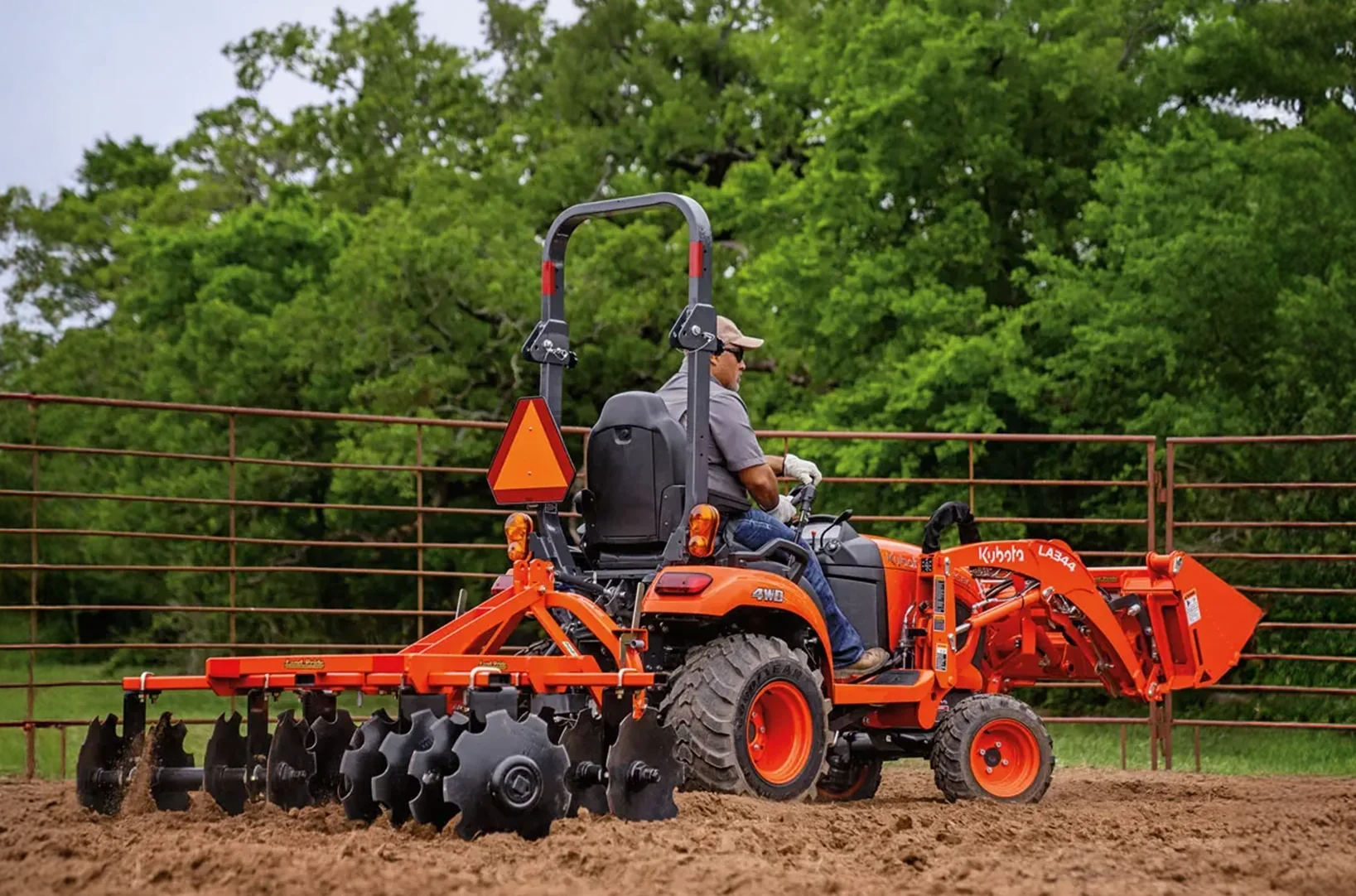
The Best Tractor for Horse Property Horse property is a different tractor problem than farmland. The machine has to fit a barn aisle, run an arena drag without chewing the footing, and move manure every single week. Width and loader capacity decide this one, not horsepower.
Quick Summary: For most Southern California horse properties, a compact tractor between 25 and 40 horsepower with a front loader is the right answer, and the deciding specs are overall width, loader lift capacity, and turning radius rather than engine horsepower. You need to fit the barn aisle and the gate between the paddocks, lift a full manure bucket to the top of a dumpster, and turn around inside an arena without a three point turn. The core implement set is a front loader, an arena drag or harrow, a box blade for the driveway and the runs, and a rotary cutter if you have pasture. This guide covers sizing, the arena question, the implements that earn their keep, and the tire choice that keeps you from tearing up the footing.
Jump to what you came for
What horse people actually ask us.
These three come up in almost every conversation. All three get answered below.
"Will it fit down my barn aisle?"
The question that decides the machine. Measure the aisle and the narrowest gate before you shop, because most barn aisles were not designed around a tractor.
"Can it lift a full bucket over the dumpster?"
Manure handling is the weekly job and dump height is the spec that makes or breaks it. This is where sub compacts sometimes come up short.
"Will it wreck my arena footing?"
Tire choice and weight decide this, not horsepower. The wrong tire on good footing is an expensive lesson, and it is entirely avoidable.
The Jobs a Horse Property Tractor Actually Does
Before you look at a single spec sheet, write down the real list. On almost every property we quote, it looks like this, and it is worth noticing how much of it is loader work rather than PTO work.
| Job | How Often | What It Needs |
|---|---|---|
| Moving manure to the pile or dumpster | Weekly or daily | Loader, dump height |
| Dragging the arena | Weekly | Drawbar pull, light footprint |
| Spreading and leveling footing | Seasonal | Loader plus box blade |
| Grading the driveway and runs | Seasonal | Box blade, weight |
| Moving hay and shavings | Weekly | Pallet forks, lift capacity |
| Mowing pasture | Seasonal | PTO horsepower |
| Fence posts and repairs | Occasional | Post hole digger, three point hitch |
Send us your job list and your barn aisle width. Those two things narrow the options almost immediately.
Sizing It Right: Width First, Horsepower Third
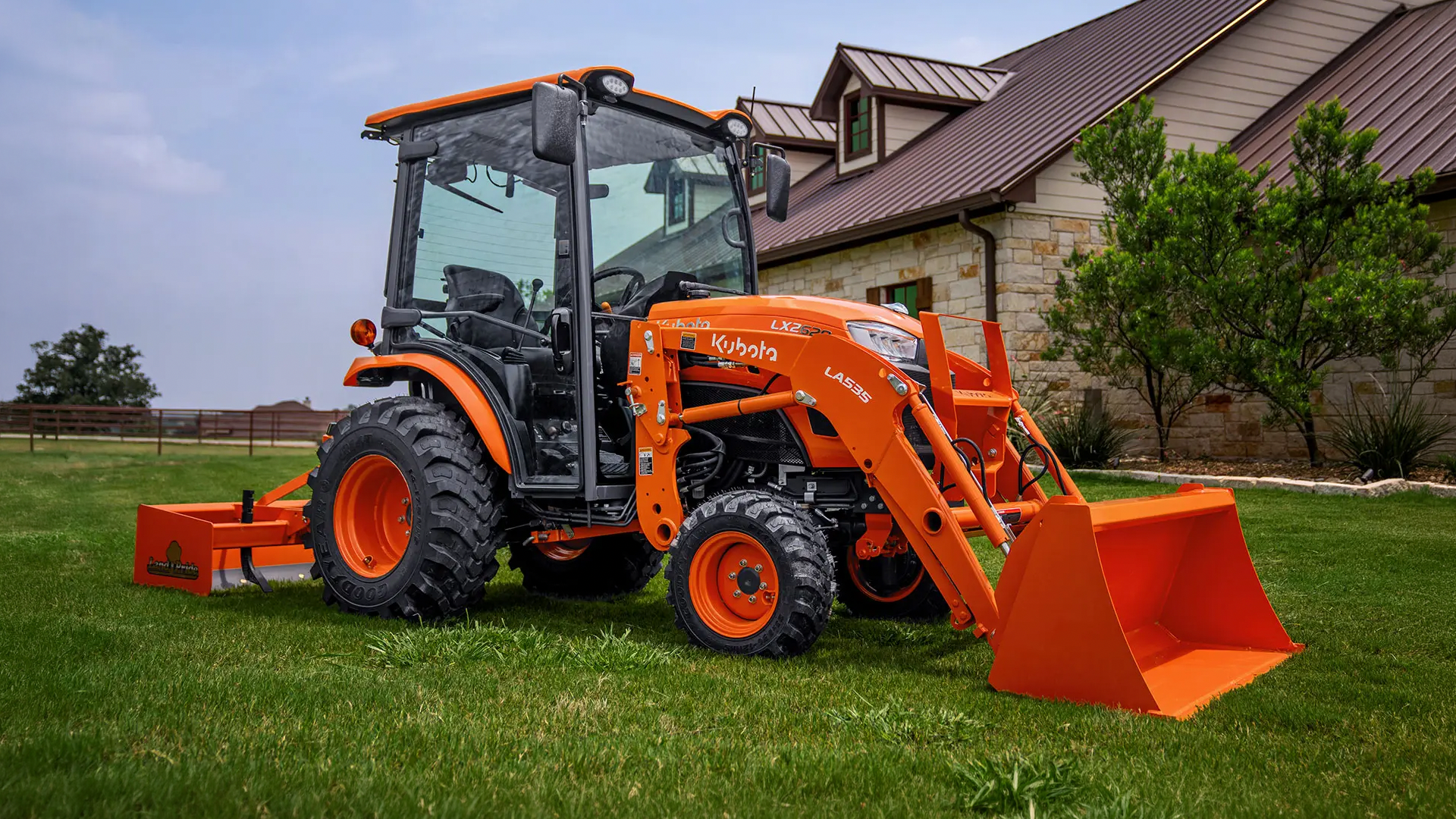
Horse properties punish oversized tractors. Barn aisles, gates between paddocks, the space between the arena rail and the fence, and the turnaround at the end of a run all set hard limits. Get the width right and then work up the horsepower from your implement list.
| Property Type | Horsepower | Kubota Series | Why |
|---|---|---|---|
| 2 to 4 horses, small arena, tight barn | 23 to 26 | BX Series | Narrow, light on footing, fits most aisles |
| 4 to 8 horses, standard arena, pasture | 25 to 31 | B or LX Series | Real loader lift, still maneuverable |
| Boarding facility, large arena, daily use | 31 to 45 | LX or L Series | Lifts pallets and bales, handles a wide drag |
| Large ranch, multiple arenas, hay | 45 to 63 | MX Series | Production capacity, wide implements |
| Property also needs trenching or footings | 23 to 26 | BX23S | Loader and backhoe on one machine |
- Measure your narrowest gate and your barn aisle before you shop. Write both numbers down
- Check overall width with the loader on, not the bare tractor width in the brochure
- Turning radius matters more here than on open acreage. Ask to try it in a marked circle
- A folding ROPS lets you get under a low barn doorway. Many horse properties need this
Want the full sizing logic including loader capacity and PTO math? Read what size tractor do I need.
Give us your aisle width and horse count and we will shortlist two machines that physically fit.
Dragging an Arena Without Wrecking the Footing
Arena work is a low horsepower, high finesse job. A drag or harrow needs very little power to pull; what it needs is a tractor that can move at a consistent slow speed and turn tightly at the ends without digging a hole. This is one of the few jobs where a smaller tractor is genuinely better than a bigger one.
The thing that damages footing is not the drag, it is the tires. Aggressive R1 ag lugs churn footing and leave ruts that then have to be dragged out, which is a loop you do not want to be in. Turf tires or R4 industrial tires with a lighter machine are the standard answer, and a tractor that is too heavy will compact the base regardless of what is on the wheels.
- Hydrostatic transmission is a real advantage here. Constant slow speed without clutching
- Turf or R4 tires. Avoid R1 ag lugs on any arena you care about
- Drag in a changing pattern so you do not build a berm on the rail
- Match drag width to the tractor so you are not overhanging into the rail on turns
Tell us your arena size and footing type and we will spec the machine and drag together.
Manure, Bedding, and Loader Dump Height
A single horse produces roughly 50 pounds of manure a day, plus bedding. Multiply that by your horse count and by seven and you have the real weekly workload. This is the job the tractor does more than any other, and it is the one people spec for last.
The specification that matters is dump height and reach at full lift, not raw lift capacity at the pivot pin. If you dump into a roll off container or a dump trailer, the bucket has to clear the top rail and reach far enough in to actually empty. Sub compacts can come up short here. Measure the container you dump into before you decide.
- Measure your dumpster or trailer rail height and compare it against published dump clearance
- A manure fork or grapple bucket beats a standard bucket for scooping stall waste
- Pallet forks handle hay, shavings, and fence material. Get them with the tractor
- Quick attach saves you real time when you switch between bucket and forks daily
Send us the height of what you dump into and we will tell you which loaders clear it.
The Implements That Earn Their Keep
You do not need everything on day one. This is the order we would buy in for a typical Southern California horse property, and the first three cover the vast majority of the work.
| Priority | Implement | What It Does |
|---|---|---|
| 1 | Front loader with quick attach | Manure, footing, hay, everything |
| 2 | Arena drag or chain harrow | Weekly arena maintenance |
| 3 | Box blade | Driveway, runs, spreading footing |
| 4 | Pallet forks | Hay, shavings, fence material |
| 5 | Rotary cutter | Pasture and weed control |
| 6 | Post hole digger | Fence repair and expansion |
| 7 | Ballast box | Safety and traction with a loaded bucket |
One note on fire season, because this is Southern California and it matters. A rotary cutter and a disc are defensible space tools as much as pasture tools. Properties in Fallbrook, Ramona, and the Temecula backcountry that keep a cutter on hand clear brush on their own schedule instead of scrambling in September.
Tell us your budget and we will tell you which three implements to buy first and which can wait.
Tires, Ballast, and Working Around Animals
A tractor on a horse property operates around animals, people, and a lot of blind corners. A few choices make the whole thing safer and they cost very little at the time of purchase.
- Turf or R4 tires. Kinder to footing, kinder to pasture, plenty of traction for this work
- Rear ballast whenever the loader is loaded. It keeps steering and braking where they belong
- A quieter machine matters more than you would think. Horses habituate to a consistent engine note
- Folding ROPS for low doorways, but keep it up and the belt on any time you are not under a roof
- Work slopes up and down rather than across. Most SoCal horse property has more grade than it looks
Keeping the machine running is the other half of the job. Read Kubota maintenance 101 for the intervals that matter in SoCal dust and heat.
Come run one on our lot before you decide. Bring your dimensions and we will do the fit check together.
Questions We Get Every Single Day
Honest answers. No script.
What size tractor do I need for a horse property?
Most Southern California horse properties are well served by a compact tractor between 25 and 40 horsepower with a front loader. Small properties with two to four horses can work with a sub compact in the BX class. Boarding facilities with a large arena and daily manure handling usually want the LX or L class. Width and loader dump height matter more than horsepower.
What is the best tractor for dragging an arena?
A lighter compact tractor with hydrostatic transmission and turf or R4 tires. Dragging takes very little horsepower, so the priorities are consistent slow speed, a tight turning radius at the ends, and tires that do not churn footing. A heavier tractor with aggressive ag tires will make more work than it saves.
Will a tractor damage my arena footing?
It can, and the tires are almost always the reason. R1 agricultural lugs dig into footing and leave ruts. Turf tires or R4 industrial tires on a machine that is not overweight for the arena will not cause problems. Machine weight also compacts the base over time, which is another argument against sizing up unnecessarily.
Do I need a backhoe on a horse property tractor?
Only if you dig regularly. Water lines, fence footings, drainage, and burial are the usual reasons. If digging comes up a few times a year, renting an excavator is cheaper. If it is a monthly thing, a machine like the BX23S that carries a loader and a backhoe together saves you a second trip and a second machine.
Sub compact or compact tractor for a barn?
Measure your barn aisle first. A sub compact fits places a compact simply will not, and on a small property it does the job. Where a sub compact runs short is loader dump height over a dumpster and PTO power for a five foot cutter. If either of those is part of your weekly routine, step up to a compact.
Can I finance a tractor for a boarding or training business?
Yes. Kubota Credit runs financing programs on qualifying new models, and if the property operates as a business, Section 179 may change the after tax cost meaningfully. Programs and eligible models change through the year, so ask what is running the week you buy rather than planning around a number you read online. Talk to your tax professional about the deduction side.
Still have a question this guide did not cover? Ask a human. That is what we are here for.
Your Machine. Your Call.
You know your work better than any spec sheet does. Bring us the jobs and we'll match the machine, with real numbers and zero pressure.
*Subject to credit approval through Kubota Credit Corporation. Terms and availability vary. Consult your tax professional regarding Section 179.