


Tyres, Ballast and What Your Loader Can Actually Lift Why the brochure number assumes weight on the back, the four ways to add it, and the combination that puts tractors on their sides
Disclosure. We sell tractors, tyres and ballast, so of course we want you to buy ballast. We would also rather not get a phone call about your tractor being on its side.
Here is the thing most new owners find out the expensive way. The number in the brochure for loader lift capacity assumes the back of the tractor is held down. If it is not, you do not get that number. You get whatever the machine can lift before the rear wheels start getting light, which is a considerably smaller number and a much more frightening one.
Ballast is not an accessory for the loader. Ballast is part of the loader. A tractor without it is a tractor with a loader that does not work properly.
This covers what ballast actually does, the four ways to add it, what to fill your tyres with, and the mistake that puts tractors on their sides.
Jump to what you came for
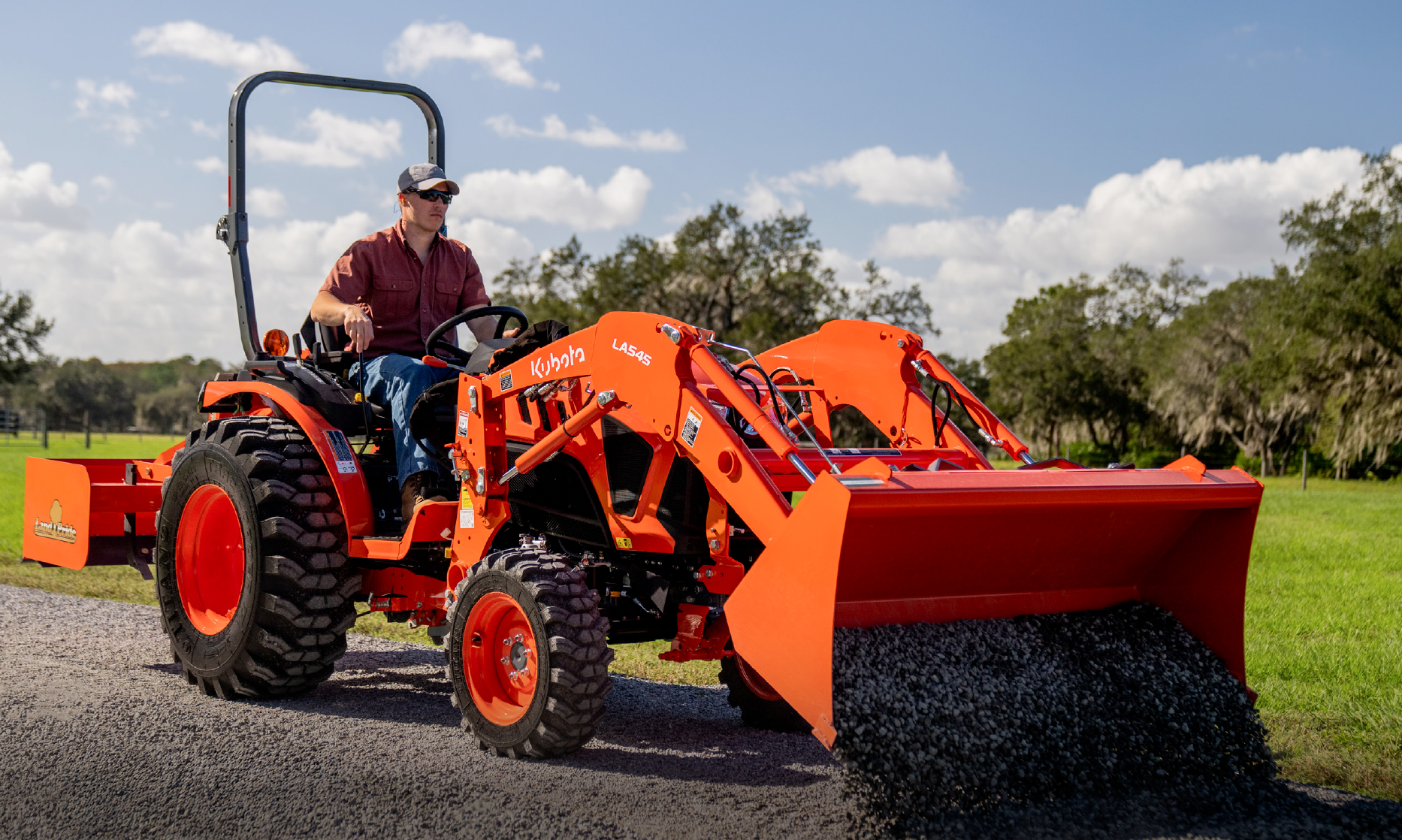
A Loaded Bucket Is Trying to Lift the Back of Your Tractor
Your front axle is the pivot. Put weight out in front of it on the end of a loader and it acts as a lever, and the thing at the other end of that lever is the rear of the tractor. The further out you extend, the longer the lever and the harder it pulls.
Three things go wrong as the rear gets light, and they go wrong in this order.
Ballast solves all three at once by putting weight behind the rear axle, where it has leverage of its own working the other way. That is the entire concept.
Four Ways to Add It, and What Each Is Good For
| Method | What it is good at | The catch |
|---|---|---|
| Filled tyres | Low centre of gravity, always there | Permanent, adds unsprung weight, and a puncture becomes a messier job. |
| Wheel weights | Bolt on, removable, low mounted | Limited total weight, and cost per pound is high. |
| Ballast box | Most effective per pound, removable | Occupies the three point hitch and has to be taken off for implement work. |
| A heavy rear implement | Free if you already own one | Only works when it is fitted, and many implements are lighter than you think. |
The important row is the ballast box one, and the reason is leverage. Weight hung well behind the rear axle has a longer lever arm than weight sitting inside the rear wheels, so a smaller amount of it does the same job. Pound for pound a ballast box is the most effective ballast available to you.
Which is why the common answer is both. Filled tyres for a permanently lower centre of gravity and better traction, plus a ballast box on the hitch when you are doing serious loader work. That combination is what most people end up with after learning the hard way, and buying it up front is cheaper than learning.
What to Put In Them
There are several options, they are not equivalent, and the cheapest one has a well earned reputation.
Tyres are filled to roughly the valve stem at the twelve o'clock position when it is at the top, which leaves an air pocket to cushion. Filling completely solid makes the ride harsh and puts load into the rim and casing that neither wants. This is a job worth having done rather than improvised, because the volumes are large and the mess is memorable.

Tyre Type Decides Where the Weight Goes
Ballast gives you weight. Tyres decide whether that weight turns into traction or into damage. The three common patterns do genuinely different jobs.
Deep lugs, maximum bite in soil
The best traction in dirt and mud by a wide margin. They also tear turf, wear quickly on hard surfaces and ride roughly on pavement. Right for field and paddock work, wrong for a machine that spends time on a finished lawn or a driveway.
The default on loader tractors, and usually correct
Shallower, wider lugs and a tougher casing. Less traction in mud than R1, far better wear on hard surfaces, less turf damage, and more puncture resistance. If your tractor has a loader and lives on mixed ground, this is almost always the right answer.
Gentle on grass, limited elsewhere
Wide and shallow to spread load and protect finished turf. Genuinely good at that one job and noticeably worse at everything else, particularly loader work in anything soft.
How Much Ballast You Actually Need
We are not going to print a formula, because the honest answer depends on your machine's weight, wheelbase, loader geometry and what you lift, and a generic number would be confidently wrong for most readers. Your operator manual gives a ballast recommendation for your specific model and loader combination, and that is the number to work from.
What we can give you is the field test, which is how most people actually check it.
Do this with the rear ballast configuration you intend to use day to day, not with an implement fitted that you take off half the time. Ballast you remove is ballast you will forget to put back on.
The Mistake That Puts Tractors On Their Sides
Almost every compact tractor rollover we hear about involves the same combination. A raised loaded bucket, a turn, and a slope. Any one of those is fine. Together they are the accident.
The Short Version
Ballast is part of the loader
Without it you do not get the lift capacity in the brochure, and you lose steering and braking as the rear goes light. Budget for it at purchase rather than after the first frightening moment.
Filled tyres plus a ballast box
Tyres for a permanently lower centre of gravity and traction, a box on the hitch for serious loader work. The box is the most effective per pound because it sits furthest back.
Use a non corrosive fill
Beet juice type solutions cost more than calcium chloride and do not quietly destroy your rims over a decade. Ask what is in the tyres of any used tractor you are buying.
R4 industrial is usually the right tyre
For a loader tractor on mixed ground, R4 beats R1 on wear and turf damage and beats R3 on everything except finished lawn. Specify deliberately rather than accepting whatever is fitted.
Five Questions Worth Asking Your Dealer
- What ballast does the manual specify for this tractor with this loader fitted?
- What do you fill tyres with, and what does it cost fitted?
- Are R4s standard on this configuration, and what would R1s change for my ground?
- What is the front axle rating, and does my intended load stay inside it?
- If I buy a ballast box, what weight do you recommend for the work I have described?
Three branches. Sun Valley, Temecula, Escondido. Same family since 1952. If a salesperson tells you ballast is optional on a loader tractor, ask a different salesperson.
Straight Answers
Why does a tractor loader need rear ballast?
Because a loaded bucket out in front of the front axle acts as a lever trying to lift the rear of the tractor. As the rear axle unweights you lose steering, since the rear wheels steer, and you lose braking, since the brakes act on the rear. The front axle also takes the whole load, which accelerates wear. Ballast behind the rear axle counteracts all three.
What is the best ballast for a compact tractor?
Usually a combination. Filled rear tyres give a permanently lower centre of gravity and better traction and are always there. A ballast box on the three point hitch is the most effective per pound, because weight hung behind the rear axle has a longer lever arm than weight inside the rear wheels. Wheel weights are a removable middle option and a heavy rear implement works only while it is fitted.
What should I fill tractor tires with?
A non corrosive beet juice type solution is the usual recommendation. It is heavy per gallon, freeze resistant and non toxic, and it does not attack steel rims. Calcium chloride is cheaper and heavy but corrosive, and a slow leak inside a rim causes quiet damage over years. Washer fluid or water with antifreeze is lighter per gallon, and foam fill solves punctures permanently but is expensive and cannot be removed.
How much do filled tires weigh on a tractor?
It depends entirely on tyre size and the fill used, so the figure comes from your tyre size and the solution's weight per gallon rather than from a general rule. Tyres are filled to roughly the valve stem at the top position, leaving an air pocket to cushion the ride, rather than completely solid.
What is the difference between R1, R4 and R3 tractor tires?
R1 agricultural tyres have deep lugs and give the best traction in soil and mud, but tear turf and wear quickly on hard surfaces. R4 industrial tyres have shallower, wider lugs and a tougher casing, offering better wear, less turf damage and more puncture resistance, and they are usually the right choice on a loader tractor working mixed ground. R3 turf tyres spread load to protect finished grass and are limited everywhere else.
How do I know if I have enough ballast?
Start from the ballast figure in your operator manual for your specific tractor and loader combination. Then test it by loading the bucket with the heaviest thing you routinely carry, raising it to full height and extending on level ground with nobody nearby. The rear wheels should stay firmly planted rather than merely touching. If they unweight, add ballast before repeating that lift.
What causes compact tractor rollovers?
The recurring combination is a raised loaded bucket, a turn and a slope. Carrying the bucket low, just clear of the ground, is the single habit that prevents the most incidents, since a raised load moves the centre of gravity up and outward. Correct ballast makes the machine behave predictably but does not make a raised load on a side slope safe. Keep the rollover bar up and the seatbelt fastened.
Yes, This Is an Ad
You just read an equipment dealer explain brush clearing. You knew what this was from the first line and read it anyway, so we will not pretend otherwise now.
What we are offering is the site walk. Send photos, or have us out, and we will tell you which of the four approaches your lot needs. Sometimes a rental. Sometimes one implement you use every spring. Sometimes your slope is too steep for any of it and you want a hand crew, in which case we will say so, because a customer who bought the wrong attachment does not come back for the tractor.
And if you are clearing ahead of the wet months, do the drainage in the same trip.
We have been here since 1952 by being the yard people call back, not the yard that sold somebody a mulcher they use twice.