


Building a Kubota Fleet for Your Landscaping Business Going from one truck and a trailer to a real fleet is a cash flow problem before it is an equipment problem. Buy in the wrong order and you own a machine that sits while you rent the one you actually needed. Here is the sequence that works.
Quick Summary: For almost every small landscape or hardscape contractor in Southern California, the first machine is a compact track loader in the SSV or SVL class, because a quick attach plate turns one payment into six or seven machines. The second purchase is usually not a second loader, it is attachments, and after that a mini excavator once you start selling drainage, irrigation main lines, and retaining walls. A compact tractor comes third for grading, decomposed granite driveways, and hauling. The two things that quietly decide your ceiling are transport, meaning what your truck and trailer can legally and safely pull, and utilization, meaning how many days a month the machine actually earns. This guide walks the sequence, the rent versus own math, the maintenance reality, and what not to buy yet.
Jump to what you came for
What growing crews keep telling us.
Three versions of the same conversation, every week, from Santa Clarita down to Chula Vista. All three get answered below.
"I am renting the same machine every week."
That is the clearest buy signal there is, but the number of rental days is not the whole answer. The rest of it is whether your work is steady enough to cover the payment in a slow month.
"Can my truck actually pull this?"
More small fleets are capped by trailer and tow rating than by budget. The machine you can finance is often bigger than the machine you can legally haul.
"Second machine or more attachments?"
Almost always attachments, for longer than most owners expect. A second machine only pays when you can put a second crew and a second truck behind it.
The Buying Sequence That Actually Works
The order matters more than the brand, the model, or the deal you got. Every contractor who has gotten upside down on equipment did the same thing: bought the machine that felt exciting instead of the machine that was already showing up on the rental invoice every week.
Here is the sequence we watch work, over and over, for crews scaling from one truck and a trailer to two or three trucks.
| Step | What You Buy | What Triggers It | What It Unlocks |
|---|---|---|---|
| 1 | Compact track loader (SSV or SVL class) | You are renting a loader most weeks | Demo, grading, material handling, hauling |
| 2 | Attachments, not a second machine | You are turning down work the loader could do | Grapple, auger, trencher, forks, brush cutter |
| 3 | Mini excavator | You start selling drainage, irrigation mains, walls | Trenching, footings, tight access digging |
| 4 | Compact tractor | Driveways, decomposed granite, acreage properties | Box blade grading, hauling, three point implements |
| 5 | Second loader or a dedicated haul truck | You genuinely have two crews running | Parallel jobs instead of a shared machine |
Tell us what you rented in the last ninety days and we will tell you honestly where you are in this sequence.
Why the First Machine Is Almost Always a Track Loader
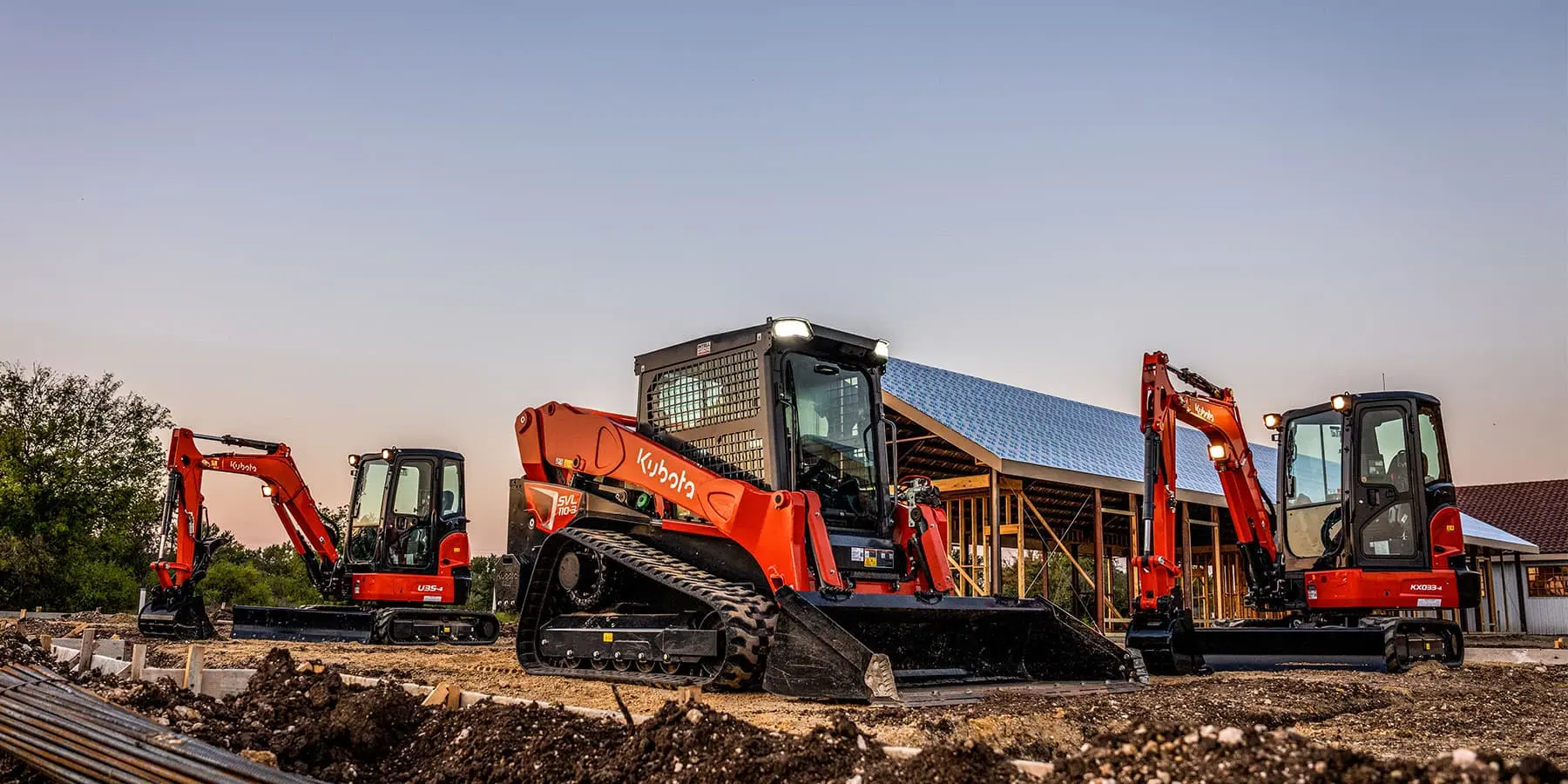
A compact track loader is the closest thing in this business to a machine that pays for itself in more than one way. On its own it is a loader. With a quick attach plate and a set of attachments it becomes a grapple truck, a post hole rig, a trencher, a forklift, and a brush cutter, and it does all of that off one payment, one insurance line, and one set of grease points.
Tracks matter in Southern California specifically. You are working on finished lawns in Rancho Santa Fe, on soft graded pads in Temecula, on hillside slopes in the Santa Monicas, and on soggy ground the two weeks a year it actually rains. A wheeled skid steer is cheaper to buy and cheaper to run, and it is the better machine on hard surfaces and demo, but a landscape crew ends up on turf and soft dirt often enough that tracks usually win.
New to this class of machine? Start with the pillar page on Kubota track loaders and skid steers, then read track loaders vs skid steers for the honest tradeoff between tracks and wheels.
Bring us your three most common job types and we will spec a loader that fits all three instead of one.
Attachments Beat a Second Machine for a Long Time
This is the advice that costs us the most short term revenue and makes us the most long term customers. Once you own a track loader, the next dollar almost always returns more in an attachment than in another machine. An attachment adds a service line without adding a payment you have to feed in January.
| Attachment | What It Adds to Your Business | Buy It When |
|---|---|---|
| Grapple bucket | Brush clearing, demo cleanup, hauling debris and palm fronds | Almost immediately. It is the most used attachment on most crews |
| Pallet forks | Pavers, block, sod pallets, plant material, bagged product | Day one if you do any hardscape at all |
| Auger | Fence posts, pergola footings, tree planting, lighting bases | When you stop subbing out post work |
| Trencher | Irrigation laterals, low voltage lighting, drain lines | When you are renting a walk behind trencher monthly |
| Brush cutter | Lot clearing, fire abatement, weed abatement contracts | Before fire season, if you want that revenue |
| Soil conditioner or rake | Final grade and seedbed prep on renovations | When hand raking is eating your labor hours |
Weed and fire abatement deserves a specific mention here, because it is Southern California. A grapple and a brush cutter on a machine you already own turn a seasonal nuisance into a real revenue line from June through October, and municipal and HOA abatement work tends to repeat every year with the same customers.
Send us your service list and we will rank the attachments by what actually pays first for your crew.
The Mini Excavator, Then the Compact Tractor
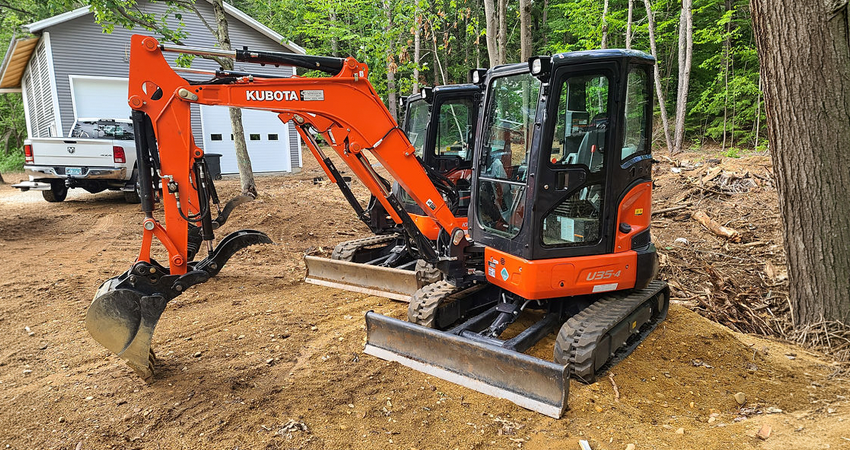
The mini excavator earns its place the moment your bid sheets start including drainage, irrigation main lines, or retaining walls. Those three jobs are where subcontractors and rental invoices quietly take the margin out of a project. A trencher handles laterals, but a main line at depth, a French drain, a dry well, or a wall footing wants a real excavator with a thumb.
Two specs decide which one. Access width, because most of your work is going through a side gate, and dig depth, because your wall footings and drain runs have a required depth you cannot negotiate with. Zero or reduced tail swing is worth paying for on residential jobs where you are working next to a fence, a house, or a neighbor's driveway.
The compact tractor is the third machine, and it is the one people are most surprised by. It shows up when your work includes decomposed granite driveways, rural and acreage properties out toward Ramona or Fallbrook or the Temecula wine country, and any job where you are box blading a long run or hauling material across a property. A tractor with a box blade and a rear blade grades a driveway more quickly and more smoothly than a loader will, and the three point hitch opens up a different implement catalog entirely.
Sizing the excavator is its own decision. Read the mini excavator sizing guide for access width, dig depth, and the tonnage class that fits residential landscape work.
Tell us the drainage and wall work in your pipeline and we will tell you if machine two is due yet.
When Renting Starts Costing More Than Owning
We rent equipment and we sell it, so we have no reason to push you either direction. The honest answer is that there is no magic number of rental days. Anyone who tells you the threshold is exactly seven days a month is selling something. What is true is that utilization is the variable that decides it, and you already have the data sitting in your rental invoices.
Run it yourself. Add up what you spent on renting one machine class over the last six or twelve months, including delivery and pickup fees, damage waiver, and the fuel surcharge, because those are real and they are easy to forget. Then compare that against what owning would cost over the same period: the payment, insurance, maintenance and wear parts, storage, and the hours somebody spends hauling and servicing it. If the rental column is comfortably larger and your work is steady, the answer is obvious. If it is close, keep renting, because renting has no commitment in a slow quarter and that flexibility is worth real money.
| Rental Pattern | What It Usually Signals | Reasonable Next Step |
|---|---|---|
| A few days a quarter | Occasional need, no consistency | Keep renting. Owning would sit idle |
| A few days most months, unpredictable | Real demand, unstable schedule | Keep renting, start tracking the invoices |
| Most weeks, same machine class | The machine is part of your process now | Run the numbers seriously. This is usually the buy point |
| Nearly every working day | You are paying a premium for flexibility you no longer need | Buy, and look at a second machine only if a second crew exists |
| Heavy for one season, dead the rest | Seasonal service line | Rent the seasonal machine, own the year round one |
Bring us your rental history and we will build the comparison with you, even if the answer is keep renting.
Transport, Crew, and the Maintenance You Skip
Here is the constraint that quietly decides machine size for most small crews, and it has nothing to do with financing. You have to get the machine to the job. Trailer capacity and your truck's tow rating cap you long before your credit line does, and California enforcement of towing weight, brakes, and licensing is not something you want to learn about on the 15 north of Escondido.
| What to Check | Why It Caps You | Where People Get It Wrong |
|---|---|---|
| Machine operating weight | The starting number for everything else | Using the base spec and forgetting the cab, tracks, and fuel |
| Attachment weight | A grapple or breaker adds real pounds to the load | Hauling the machine plus two attachments on a trailer rated for the machine alone |
| Trailer GVWR and axle rating | The trailer, not the truck, is usually the first limit | Assuming a common tandem axle trailer covers any compact machine |
| Truck tow rating and payload | Tongue weight eats truck payload before you load a single tool | Reading the marketing tow number instead of the door jamb sticker |
| Brakes, licensing, and insurance | Legal exposure, not just mechanical | Finding out at a weigh station or after an incident |
Then there is the part nobody puts on the spreadsheet. Somebody has to run the machine, and somebody has to grease it. On a two or three person crew those are usually the same person, and that person is also selling, bidding, and driving. Neglected machines do not fail politely. They fail on a Thursday with a customer standing there and a paver delivery scheduled, and the repair costs more than three years of the maintenance you skipped.
Not sure what your truck and trailer can actually carry? Tell us what you tow with and we will size to it.
Financing and Section 179 as Cash Flow Tools
Financing is not about whether you can afford a machine. It is about keeping working capital in the business while the machine earns. A landscape contractor who drains the account to pay cash for a loader in March and then cannot float payroll on a slow April has solved the wrong problem.
The practical framing is simple. Structure the payment so the machine covers it in a below average month, not an average one. Look at what the machine replaces on your rental invoices and what new service lines it opens, and make sure that number clears the payment plus insurance plus a maintenance reserve with room left over. If it only works in your best month, the term or the machine is wrong.
Section 179 and bonus depreciation can meaningfully change the after tax cost of equipment for a business, which is why so much equipment moves in the fourth quarter. Limits, phase outs, eligibility rules, and how they interact with your specific entity and income change from year to year. Timing a purchase around the calendar year is a legitimate strategy, and it is also exactly the kind of decision that should involve someone who has seen your books.
Thinking about a year end purchase? Read the Section 179 equipment deduction guide, and see our track loader and skid steer lineup for what is on the ground now.
Talk to us about structure before you talk about price. The payment shape matters more than the sticker.
Questions Contractors Ask Us Every Week
Honest answers. No script.
What equipment should a landscaping business buy first?
For most small landscape and hardscape contractors, the first machine is a compact track loader in the SSV or SVL class. It handles demo, grading, and material handling on its own, and with a quick attach plate it becomes a grapple, an auger, a trencher, and a forklift off a single payment. Buy the machine that already shows up on your rental invoices most often, not the one that looks the most capable.
Should a landscaping business buy a track loader or a skid steer?
Track loaders usually win for landscape work because so much of the job happens on turf, soft graded pads, and slopes where a wheeled machine tears things up or loses traction. Wheeled skid steers cost less to buy and less to run, and they are better on pavement and heavy demo. If most of your work is finished residential landscape, go with tracks. If most of it is hardscape demo on concrete, wheels are worth a serious look.
How many rental days a month means I should buy?
There is no honest magic number, and anyone who gives you one is guessing at your business. The pattern that matters is consistency. If you rent the same machine class most weeks and your work is steady year round, ownership is usually cheaper. Add up twelve months of rental invoices including delivery, damage waiver, and fuel charges, compare it against payment plus insurance plus maintenance plus your own hauling time, and let your numbers decide.
Do I need a mini excavator for a landscaping business?
Only once drainage, irrigation main lines, or retaining walls become a regular part of what you sell. A trencher on your loader covers irrigation laterals and lighting. When you are digging French drains, dry wells, or wall footings at depth on a monthly basis, the excavator stops being a rental and starts being machine two. Gate access width and dig depth are the two specs that decide which size fits your work.
What limits the size of machine my crew can run?
Transport, almost always. Your trailer rating and your truck's tow and payload capacity cap machine size long before financing does. Check the machine's operating weight with the options you actually want, add the attachments you plan to haul with it, then compare that against the trailer GVWR and the payload sticker in your truck door jamb. Get this right before you shop, because it eliminates entire size classes.
Can Section 179 help me buy landscaping equipment?
It often can, which is why so much equipment moves in the fourth quarter, but the rules depend on your entity, your income, how the equipment is used, and the tax year. We sell and rent equipment, we are not your CPA, and we will not pretend otherwise. Talk to your tax professional before a deduction drives the decision. If the machine does not pay for itself operationally, no tax treatment will rescue it.
Still have a question this guide did not cover? Ask a human. That is what we are here for.
Your Machine. Your Call.
You know your work better than any spec sheet does. Bring us the jobs and we'll match the machine, with real numbers and zero pressure.
*Subject to credit approval through Kubota Credit Corporation. Terms and availability vary. Consult your tax professional regarding Section 179.