


Work Machine or Weekend Toy: The Honest Difference A Kubota RTV and a sport side-by-side look close enough in a parking lot and behave nothing alike on your property. Here is the plain English version, without the showroom pitch.
Quick Summary: The quick rule up front: if the machine's main job is hauling, towing, and getting work done on your property, an RTV is built for exactly that. If its main job is covering ground fast for fun, a sport side-by-side is the better toy. Kubota builds RTVs the way it builds tractors: diesel power, a hydrostatic transmission with real engine braking, a steel cargo bed, and a chassis meant to run loaded at low speed all day. This guide covers the real difference, which machine fits your use, diesel versus gas, what each honestly costs to own, and the RTV models most SoCal buyers land on.
Jump to what you came for
Questions every buyer is already asking.
If you're shopping utility vehicles, one of these is probably sitting in the back of your head. All three get answered below.
"Is an RTV just a slower side-by-side?"
No. Different transmission, different chassis, different job description. The speed difference is the symptom, not the cause. We lay out what actually changes below.
"Do I need diesel, or is gas fine?"
Depends entirely on whether the machine works or plays. Diesel wins under load and over the long haul. Gas wins on top speed and sticker price. The honest split is in the diesel section.
"Which RTV should I be looking at?"
For most SoCal buyers it comes down to the RTV-X900, the cabbed RTV-X1100C, the crew-hauling RTV-X1140, or the gas Sidekick. The lineup section sorts them by the work you actually do.
Same Size, Different Job Description
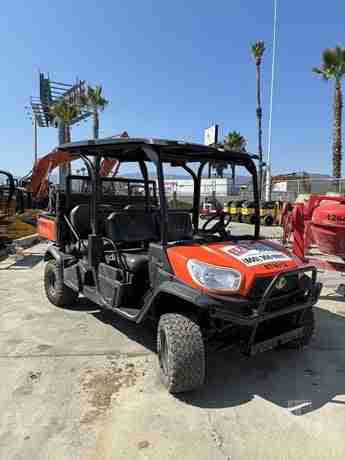
Park a Kubota RTV next to a sport side-by-side and they look like cousins. They aren't. Kubota engineers the RTV as a small tractor with a bed on the back: diesel engine, hydrostatic transmission, heavy frame, real cargo capacity. A sport machine is engineered around a high-revving gas engine, a CVT belt, and long-travel suspension so it can move fast over rough ground. Everything else follows from that one decision.
| What Matters | Kubota RTV | Sport Side-by-Side |
|---|---|---|
| What it was designed to do | Haul, tow, and work | Cover ground fast |
| Transmission | Hydrostatic, like a tractor | CVT belt drive |
| Top speed | About 25 mph on diesel models | Considerably faster |
| Loaded downhill control | Real engine braking | Belt slips and heats |
| Cargo bed | Steel, hydraulic dump available | Lighter duty, often plastic |
| Running loaded all day | What it was built for | Wears the driveline |
| Drive belt to replace | None | Yes, a regular consumable |
| Ride over rough ground fast | Firmer, work tuned | Long travel suspension |
Not sure which side of that line your property falls on? Tell us what you'd use it for in a normal week and we'll tell you straight.
Which One Fits Your Use: Match the Machine to the Property
Forget the spec sheet for a minute. Picture a normal Tuesday on your place and count what the machine actually does. Feed runs, fence repairs, hauling tools to the back of the property, moving gravel, pulling a sprayer. Then match it to that. Buy for the ordinary week, not the one weekend a year you take it up a trail.
| What You Actually Do | Recommended | Kubota to Look At |
|---|---|---|
| Chores, feed runs, fencing on acreage | Work RTV, diesel | RTV-X900 |
| Same work, plus heat, dust, and long days | Cabbed RTV with AC | RTV-X1100C |
| Hauling a crew and cargo on the same trip | Convertible bed RTV | RTV-X1140 |
| Covering big acreage quickly, mixed work and fun | Gas, higher speed | RTV-XG850 Sidekick |
| Vineyard and grove rows, tight turns, light loads | Compact RTV | RTV520 |
| Jobsite tool hauling and site runs | Work RTV, diesel | RTV-X900 / RTV-X1100C |
Still torn? That usually means your use is genuinely mixed, and the real question becomes which half you'd hate to compromise on. A few quick questions about your property and we'll tell you exactly what we'd buy if it were our money.
Tell us the three things you'd use it for most and we'll match the machine in one conversation.
Diesel or Gas: The Part People Get Wrong
Most buyers assume this is a fuel-price question. It isn't. It's a duty-cycle question. Diesel makes its torque low in the rev range, which is exactly where a loaded utility vehicle lives: crawling up a grade with a half ton of gravel, pulling a sprayer through soft ground, easing down a hill you'd rather not ride the brakes on. Gas engines make their power higher up, which is why the gas machine feels quicker and empty and works harder to do the same loaded job.
The second half of the answer is the fuel you already keep. If there's a tractor on the property, there's diesel on the property. One fuel, one can, one trip to town. That convenience is worth more to most ranch and grove owners than any per-gallon math.
Where gas earns its place: top speed and purchase price. Kubota builds the RTV-XG850 Sidekick specifically for buyers who want to cross a large property quickly and still haul something when they get there. It's the Kubota that competes most directly with a recreational side-by-side, and for the right buyer it's the right answer.
Fuel economy, speeds, and capacities vary by model, options, and how the machine is loaded. Figures here are typical ranges, not specifications.
Want the real operating cost picture for your hours and your terrain? We'll walk you through it with actual numbers.
What It Really Costs to Own, Not Just to Buy
Sticker price is the easiest number to compare and the least useful one. The number that matters is what the machine costs you over five years, and on a utility vehicle that comes down to three things: what you replace, what you don't, and what it's worth when you're done.
A belt-driven machine that works hard eats drive belts. That's not a defect, it's the design. A hydrostatic RTV doesn't have that line item at all. On the other side, an RTV asks for engine oil, filters, and hydraulic service the same way a tractor does, and it rewards you for keeping up with it. Neither machine is free to run. They just cost money in different places.
Resale is where the gap usually shows up. Clean, low-hour Kubota RTVs hold their value unusually well in the SoCal market, because the buyers here are ranch, grove, and contractor buyers who want a machine that works. That's the same reason a five-year-old sport machine with a hard life on it is a harder sell.
Buying is only half the math. See how the money side works in Kubota financing explained, then come back to the machine.
Wondering what your current machine is worth on a trade? Ask us for a straight number, no obligation attached.
The RTV Lineup: Where Most Buyers Land
Kubota builds the RTV series around work, with one gas model aimed squarely at buyers who also want speed. Here's the short version of who buys what.
RTV-X900
The straightforward diesel workhorse. Chores, feed runs, fencing, and hauling on acreage without paying for a cab.
Best for: property owners
RTV-X1100C
The cabbed version most buyers land on. Factory cab with heat and air, which in a SoCal summer stops being a luxury fast.
Best for: most buyers
RTV-X1140
Four seats that convert to a full cargo bed in about a minute. The crew-and-cargo answer when you need both on one trip.
Best for: crews and families
RTV-XG850 Sidekick
The gas machine. Roughly 40 mph, still a real cargo bed. Kubota's answer for buyers who want speed and utility in one.
Best for: big properties
The RTV520 sits below all of these: a smaller, lighter diesel that fits down vineyard and grove rows, tucks into a trailer easily, and does light chores without being more machine than the job needs. If your rows are tight or your storage is tighter, start there.
Buyers cross-shop the RTV against Polaris, Can-Am, and John Deere, and all of them build a capable machine. Where the RTV consistently wins for working buyers: the hydrostatic transmission with no drive belt, diesel torque at the bottom of the rev range, a cargo bed built out of steel, and Kubota's parts and service network. Our take as a dealer that services what we sell: buy the machine with the best support within an hour of your property. If that's us, the RTV-X1100C is the one that leaves our lot most often, and the cab is why.
On the money side, Kubota Credit periodically runs $0 down and low APR programs on qualifying new models. Programs, terms, and eligible models change, so ask us what's running right now on the machine you want.
*Financing subject to credit approval through Kubota Credit Corporation. Programs and availability vary.
Moving more dirt than cargo? Start with our mini excavator sizing guide or the track loader vs skid steer breakdown.
Fifteen minutes in the seat beats an hour on spec sheets. All three lots keep RTV units ready to run.
Questions We Get Every Single Day
Honest answers. No script.
Is a Kubota RTV the same thing as a side-by-side?
Broadly they are the same category of vehicle, but they are engineered for different jobs. Kubota RTVs are built around work: diesel power, a hydrostatic transmission with real engine braking, a heavy steel cargo bed, and towing capacity. Sport side-by-sides are built around speed and suspension travel. Both are UTVs. Only one is designed to run loaded all day.
Should I buy a diesel RTV or a gas one?
Buy diesel if the machine works: better low end torque, better fuel economy under load, longer service life, and the same fuel your tractor already burns. Buy gas if you want higher top speed and a lower purchase price, which is exactly what the RTV-XG850 Sidekick is built for.
How fast does a Kubota RTV go?
The diesel RTV-X models top out around 25 mph, which is deliberate. They are geared for pulling, not sprinting. The gas RTV-XG850 Sidekick runs up to roughly 40 mph. Sport side-by-sides go a great deal faster and do a great deal less work.
Can a Kubota RTV tow a trailer?
Yes. Towing capacity varies by model, and the RTV-X series is rated in the neighborhood of 1,300 pounds. Match the hitch, the trailer, and the terrain. Engine braking on a hydrostatic transmission is one of the RTV's real advantages on a loaded downhill haul.
Do RTVs use a drive belt like a side-by-side?
No, and that is one of the biggest practical differences. RTVs use a hydrostatic transmission rather than a CVT drive belt, so there is no belt to slip, glaze, or burn on a long loaded climb. One less consumable and one less way to get stranded on the back of your own property.
Are utility vehicles street legal in California?
Not by default. California treats most utility vehicles as off highway vehicles, and street legality depends on your county, how the machine is equipped, and how it is registered. Some agricultural uses have their own rules. Check with your local DMV, or ask us what other buyers in your county have done.
Still have a question this guide didn't cover? Ask a human. That's what we're here for.
Your Property. Your Call.
You know your work better than any spec sheet does. Bring us the jobs and we'll match the machine, with real numbers and zero pressure.
*Subject to credit approval through Kubota Credit Corporation. Terms and availability vary. Consult your tax professional regarding Section 179.