

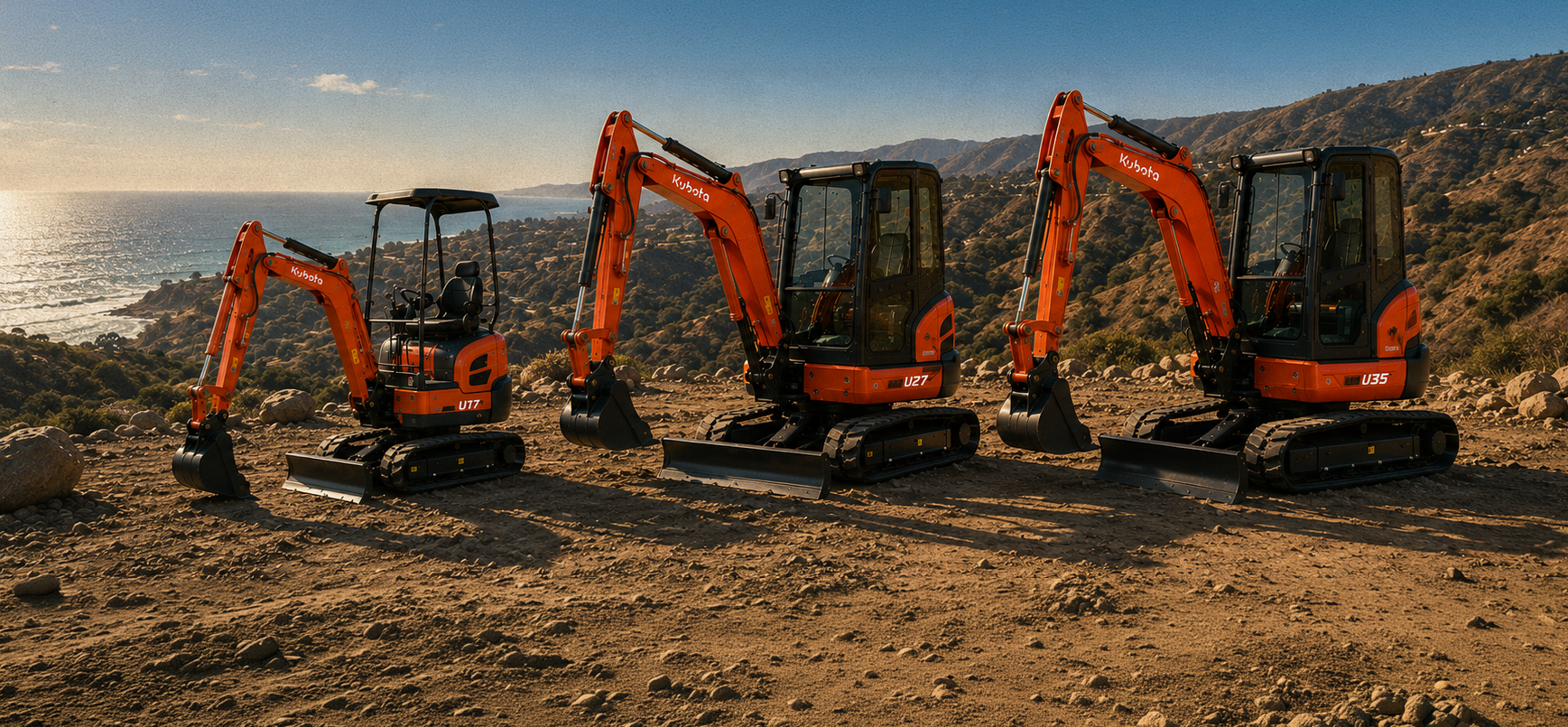
The Machine Is the Easy Part What a mini excavator weighs, what California law says about hauling it, and the mistakes that put people in a ditch on the 15
Disclosure first. We sell mini excavators and we rent them, so we load these onto trailers most days of the week and we have paid for the mistakes.
We have also watched customers hook up to a rental and pull out of the yard on a setup that was not legal. Sometimes we catch it. Sometimes the truck is on the street and nobody asked us.
So here is the conversation we would rather have before you reach the gate. Weight first, because almost every bad towing decision starts with a guess about weight. Then the law, which we went and read. Then loading, which is where people get hurt.
If you came here hoping for permission to pull the machine you already rented with the truck you own, the answer might be no. The cheapest version of no is a delivery fee.
You spend tens of thousands on the machine, then find out the truck and trailer to move it are their own five figure problem.
Jump to what you came for
What a Mini Excavator Actually Weighs
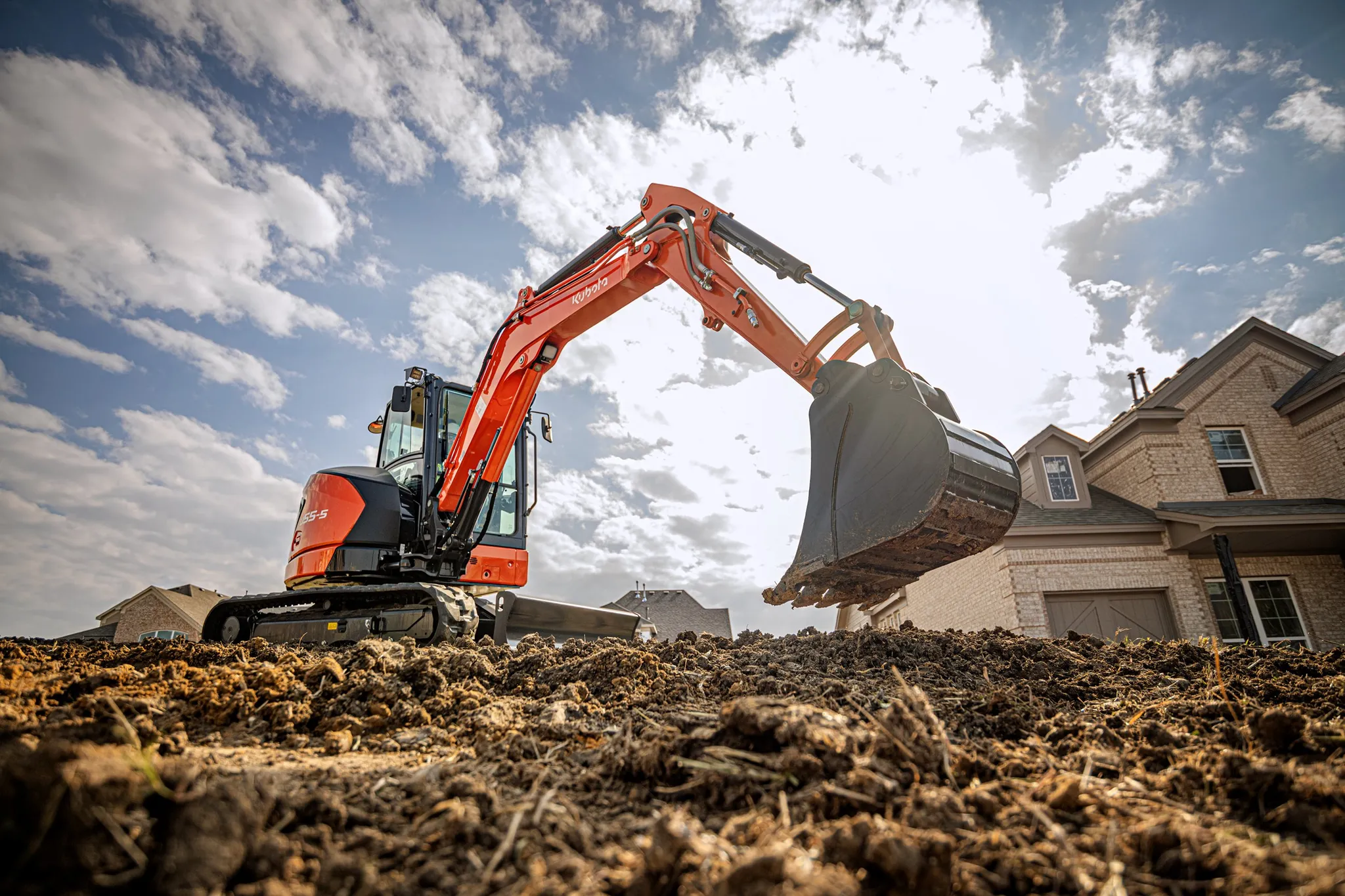
The operating weight on a spec sheet describes one machine in one configuration, and it is almost never the machine in front of you. It leaves out the thumb somebody added, the grading bucket you swapped on, and the spare bucket on the deck. Fuel and operator may or may not be in there.
So every figure you find online starts a conversation, it does not end one. The trade sorts these into rough tonnage classes, and the class name is a naming convention, not a weighing.
| Class | What it is for | The towing conversation |
|---|---|---|
| One ton class | Backyards, side gates, interior demo. | Easiest haul in the category. Confirm your own ratings anyway. |
| Under two ton, U17 territory | The rental favourite. Trenching, footings, irrigation, gated lots. | Where most homeowners live. Start checking numbers instead of eyeballing them. |
| Three to four ton, KX033 and U35 and KX040 | The contractor default. Still fits most residential access. | The class that quietly pushes people past a 10,000 pound trailer rating once machine, attachments and trailer are added up. |
| Five ton class | Production digging, utility work, bigger footings. | Three quarter ton and one ton trucks. Assume the license question below applies. |
| Eight ton class, KX080 territory | Top of compact. Real depth and real production. | Not a pickup and a rented trailer. A dedicated rig or a lowbed, and most owners pay someone. |
Honest note. These are class labels the trade uses, not weights we measured, and we have deliberately not printed a pound figure beside a model name we could not verify. The only weight that counts legally is what a certified scale reads with your machine, bucket, thumb and trailer on it.
Which California License You Need to Tow It
Everything below was checked against the California Vehicle Code itself, on the state legislature's website, and against the DMV's own Recreational Vehicles and Trailers Handbook. We name the sections so you can read them instead of taking traffic law from an equipment dealer.
It turns on one number, and it is not your machine. It is the gross vehicle weight rating of your trailer, set by the manufacturer and stamped on the frame. It does not shrink because today's load is light.
| The rule | What the code says | Where we got it |
|---|---|---|
| Basic Class C | Covers a two axle vehicle rated 26,000 pounds GVWR or less, including when towing a trailer rated 10,000 pounds GVWR or less. | Vehicle Code 12804.9(b)(3)(A). |
| Over that trailer rating | A combination where the towed vehicle is rated over 10,000 pounds falls into Class A. For private, not for hire towing, DMV issues a noncommercial Class A. | Vehicle Code 12804.9(b)(1)(A), plus the DMV handbook. |
| Light tow vehicles | No motor vehicle under 4,000 pounds unladen may tow anything weighing 6,000 pounds or more gross, and no passenger vehicle may tow more than one vehicle. | Vehicle Code 21715(a) and (b). |
| Trailer brakes | A trailer built and first registered after January 1, 1966 with a gross weight of 3,000 pounds or more needs brakes on at least two wheels. | Vehicle Code 26302(b). |
| Speed while towing | 55 miles per hour, maximum, drawing any other vehicle. | Vehicle Code 22406(a) and (b). |
Two caveats. We are a dealer, not a lawyer or a DMV field office, so treat this as the prompt to confirm rather than the last word. And commercial use changes things, because hauling for your business pulls in rules a weekend haul never touches.
Brakes, Breakaway Cables and the 55 Mile an Hour Rule
Nobody gets excited about trailer brakes. Then somebody merges in front of you on the 15 outside Temecula and you learn what your stopping distance really is.
None of it is exotic. A brake controller, a charged breakaway battery, and a right foot that accepts 55.
Which Trailer for Which Machine

One and two ton class
A single axle utility trailer is usually wrong even here. Narrow deck, short ramps. A small tandem axle equipment trailer with real ramps and brakes on both axles is the buy.
Three to four ton class
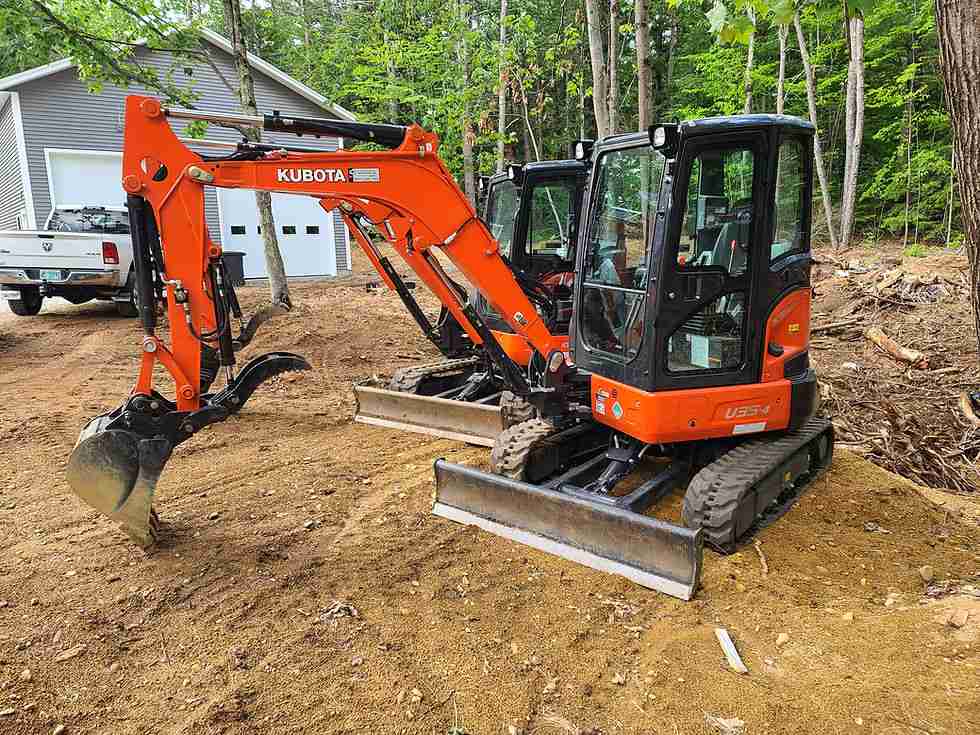
Tandem axle, full width deck, ramps long enough to keep the approach angle sane. This is where the rating plate starts deciding which driver's license you need, so read it first.

Five ton and up
Deckover or lowbed, dually truck, and an honest look at whether you want to own this problem. Plenty of contractors who own the machine still pay someone to move it. That is a read on what a bad day costs.
Not sure which class you are shopping? Start with compact excavator vs mini excavator, then why smaller machines win.
The Short Version
A basic California Class C covers you, assuming a two axle truck rated 26,000 pounds or less. Vehicle Code 12804.9. Most readers are here.
Class A territory. For private towing that is a noncommercial Class A from DMV. Do not improvise, call DMV about your combination.
You may not tow anything weighing 6,000 pounds or more gross. Vehicle Code 21715. That rules out small SUVs people insist will be fine.
Pay for delivery. A trailer you use twice a year still needs registration, tires that age out whether you drive on them or not, and somewhere to park.
Read the plate on your trailer and the door jamb sticker on your truck, then call us with both numbers.
Ask for the weight of the actual machine with the attachments you are taking. Better than an internet average.
Talk to someone who loads theseGetting the Machine on the Deck
The legal part is paperwork. This part sends people to the hospital, and nearly all of it is angles and where the machine ends up sitting.
The trailer never fails in the yard at three miles an hour. It fails on a downgrade, in wind, with a truck alongside.
Chains, and How Many California Wants
This is the one we see wrong most often, and one of the few with a clear answer in the code.
Vehicle Code section 29004(a)(3) says a vehicle transported as a load on a trailer shall be secured by at least four tiedown chains, straps or an equivalent device, independent of the winch or loading cable. Four. Independent of the winch. We read that section on the legislature's own site.
What Happens at a CHP Scale, and Why This Page Is Not Enough
Here is the uncomfortable part. Everything above is accurate as far as it goes, and it still does not replace the calls you should make.
CHP enforces load and commercial vehicle rules at the scales and on the road, and the officer at your window has the current version of every rule here plus the ones we did not cover. If your haul is commercial, that conversation is wider than a blog post.
We sell excavators. Traffic law is not our trade, and an article that pretended otherwise would be the thing you should not trust.
So use this to know which questions to ask. When you are choosing who to rent or buy from, these four tell you who you are dealing with:
- Will you give me the weight of this actual machine, with the attachments I am taking, before I show up with a trailer?
- Will someone look at my truck and trailer in the yard and tell me if the setup is wrong, even if that costs you the walk out?
- What does delivery cost, and is it cheaper than the day I would spend sorting out a trailer?
- If I get to the job and the machine is the wrong size, what actually happens next?
Three branches. Sun Valley in Los Angeles, Temecula in Riverside County, Escondido in San Diego. Same family since 1952. Ask us those four, then ask whoever else.
Straight Answers
How much does a mini excavator weigh?
It depends on the class and on how the machine is equipped, and we will not print a pound figure beside a model name we have not verified for your serial number. The trade sorts these into rough tonnage classes, from a one ton machine that fits through a side gate up to an eight ton machine at the top of the compact range. Published operating weight is a starting point, not your load, because it ignores the thumb, the bucket you swapped on, and the trailer.
What license do I need to tow a mini excavator in California?
It turns on your trailer's gross vehicle weight rating, not the machine. California Vehicle Code section 12804.9 puts a two axle vehicle rated 26,000 pounds GVWR or less under a basic Class C license, including when it is towing a trailer rated 10,000 pounds GVWR or less. Once the towed vehicle is rated over 10,000 pounds you are into Class A, and for private towing that is a noncommercial Class A from DMV. Commercial use can change that, so confirm with DMV.
Do I need trailer brakes to tow a mini excavator in California?
Almost certainly yes. California Vehicle Code section 26302 requires a trailer built and first registered after January 1, 1966 with a gross weight of 3,000 pounds or more to have brakes on at least two wheels. An older provision covers trailers of 6,000 pounds or more operated at 20 miles an hour or over. Section 26458 also requires the combination to brake from one control, with an exception for trailers using inertially controlled breakaway brakes that hold the trailer stationary for not less than 15 minutes.
How fast can you drive while towing a trailer in California?
55 miles per hour, maximum. California Vehicle Code section 22406 caps a motortruck or truck tractor drawing any other vehicle, and a passenger vehicle or bus drawing any other vehicle, at 55 miles an hour on a highway. That applies statewide regardless of the posted limit, so a freeway signed for 70 does not raise your ceiling.
How many chains do I need to tie down a mini excavator?
At least four. California Vehicle Code section 29004, subdivision (a)(3), requires a vehicle transported as a load on a trailer to be secured by at least four tiedown chains, straps or an equivalent device, independent of the winch or loading cable. Use the tie down points the manufacturer marked, angle two forward and two back so the chains oppose each other, and never run a chain over a hydraulic line.
What size trailer do I need for a mini excavator?
Big enough that the machine, its attachments and the trailer itself all sit under the trailer's rating, and long enough that the ramps do not create a break over angle that high centres the machine at the transition. In practice that means a tandem axle equipment trailer with brakes on both axles and real ramps, even for the smallest machines. Narrow utility trailers with short ramps are where loading accidents happen.
Yes, This Was an Ad
You just read an excavator dealer spend three thousand words on trailers. You saw it coming from the first paragraph, so we will skip the close.
Here is the offer instead. Bring your truck and trailer to any of our three branches and we will look at the setup before anything gets loaded. Read the plates, weigh the machine you are taking, and tell you plainly if you should not pull it.
If delivery is cheaper and safer than a trailer you would use twice a year, we will say so and quote it. We would rather bill you a delivery fee for ten years than lose you over one bad haul.
We have been here since 1952 by being the yard people call back, not the yard that let somebody leave on a setup we knew was wrong.