

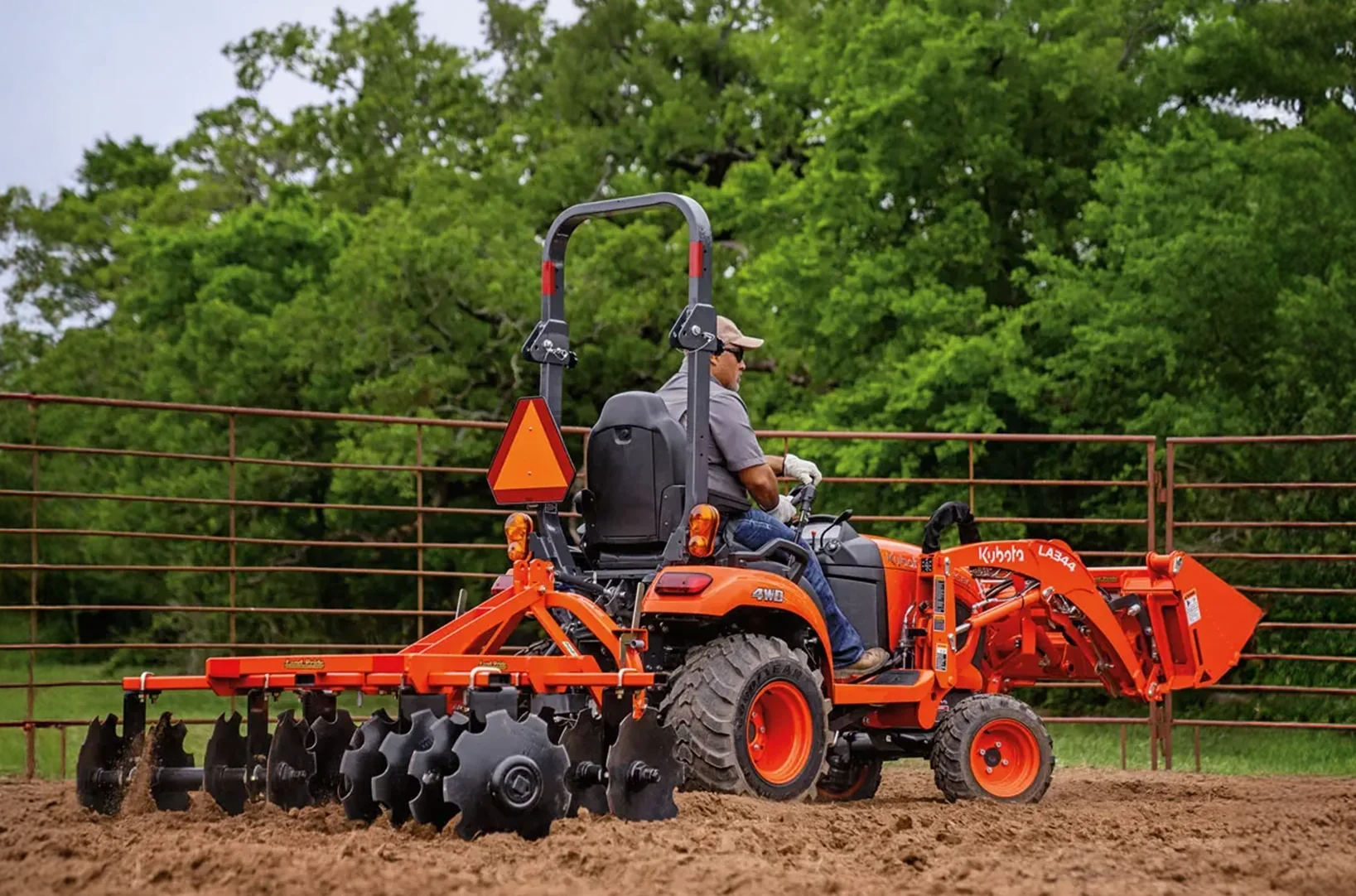
Can a Compact Tractor Really Handle a Muddy Property? Sometimes. Four-wheel drive, the right tires and ballast get you further than you think, and none of it beats waiting a week for the ground to dry
Disclosure. We sell Kubota tractors, so we have every reason to tell you one will conquer your mud. It won't, not always. Here is what a compact tractor can really do on wet ground, and when to park it.
Short answer: A compact tractor with four-wheel drive, the right tires and proper rear ballast can work damp ground and drive across soft spots, but no compact tractor floats on saturated clay. If the ground squishes underfoot or water stands in the tire tracks, the honest move is to wait for it to dry, because every pass you make now becomes a rut you fix later.
Mud doesn't care what color your tractor is.
We get this question every winter, usually from someone whose tractor is axle deep in a horse paddock. The answer depends on a few things you control and one you don't: the weather.
Jump to what you came for
What Actually Gets a Tractor Through Mud
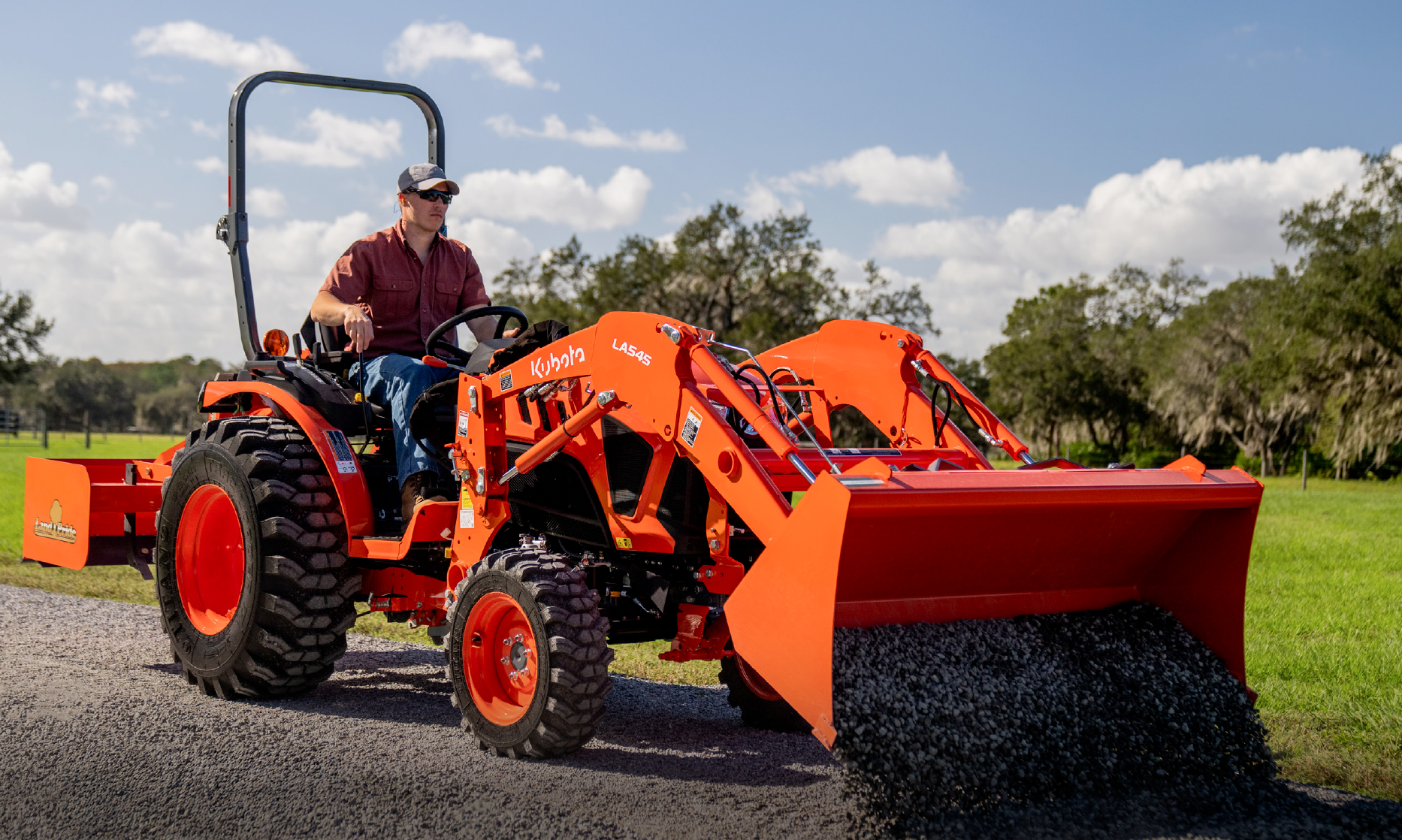
No magic option. Traction on wet ground comes from a few boring things working together.
Four-wheel drive, and actually using it
Most compact Kubota tractors sold for property work have four-wheel drive, and on many models you engage it with a lever. People forget. Engage it before the soft spot, not after you are spinning and the rear tires have dug a hole.
Tires that match the ground
Tread matters more in mud than almost anything else on the machine. Next section.
Ballast in the back
Ballast is extra weight added to a tractor, usually on the rear, to keep the tires planted. It helps traction. It also adds weight, which on soft ground is a mixed blessing.
Slow and steady speed

Tires Decide More Than Horsepower
Most mud complaints we hear are really tire complaints.
Compact tractors come with three common tire types. The labels R1, R3 and R4 are industry codes for the tread pattern. Here is how they compare when the ground is wet.
| Factor | R1 agricultural | R4 industrial | R3 turf |
|---|---|---|---|
| Traction in mud | Best | Middle | Worst |
| Lawn damage | Tears it up | Some | Gentlest |
| Loader work on hard ground | Fine, a bit bouncy | Built for it | Fine |
| Gravel, DG and pavement | Wears faster | Handles it well | OK |
| Who it suits | Pastures, orchards, real mud | Mixed use, most loader tractors | Lawns and finished yards |
R1: the mud tire
Tall lugs, widely spaced. They bite and shed mud. For a property that is mostly dirt, pasture or paddock, the honest pick. They also chew up lawns.
R4: the in-between
Shorter, closer lugs. This is what most loader tractors wear because it handles gravel, decomposed granite (DG, the crushed granite many SoCal driveways and paths are made of), pavement and moderate mud reasonably well. It is a compromise. In real mud it packs up faster than an R1.
R3: the lawn tire
Shallow tread, gentle on grass, and the first tire to turn into a slick in wet clay. Stuck on turf tires? That is probably why. It is not you.
We go deeper on tire choice, liquid fill and ballast boxes in our tractor tires and ballast guide. If you are buying this winter, our guide to what first-time tractor buyers overlook covers tire choice as part of the bigger picture.
Weight and Ballast: Help and Hurt
Here is the part that confuses people. Weight on the drive tires helps traction. Weight overall makes a machine sink. Both are true at the same time.
Why ballast still matters
Rear ballast is required when you run a front loader. It keeps the rear tires on the ground and the tractor from tipping forward with a full bucket. Common options are a box blade or ballast box on the 3-point hitch (the three-arm lift on the back of the tractor), or liquid-filled rear tires. Read your operator's manual for what your tractor needs. Without ballast, a loader tractor on wet ground has light rear tires that spin easily.
Why heavier is not always better
Soft ground gives way under weight. A heavier tractor sinks deeper and leaves deeper ruts, so bigger is not automatically the answer. A lighter machine kept off the wet spots often does less damage.
What a Compact Tractor Can't Do in Mud
We'd rather you hear this from us than find out in the paddock.
It can't work saturated clay
Parts of LA County, Riverside County and San Diego County sit on expansive clay. It drains slowly and swells when wet, so water sits on top. When it is soaked, it turns into grease. No tire tread works in grease. You will spin, slide and leave a trench.
It can't work a wet slope
Hillsides are where this gets dangerous. A tractor that slides sideways on a wet hill can tip. We don't run equipment on saturated slopes, in moving water or during a storm warning, and neither should you. No job on a residential property is worth that.
It can't fix the reason the ground is wet
A tractor can help regrade a low spot once the ground dries. It can't decide where the water should go. If water sits in the same place every winter, that is a drainage problem. Anything involving slopes, walls or water heading toward a neighbor's lot needs a civil engineer, a licensed grading or landscape contractor, or your city or county involved.
When to Just Park It and Wait
The cheapest mud solution is a calendar.
Southern California wet spells are usually short. Most properties are workable within days of a storm, a week or more on heavy clay. Waiting costs nothing. Rutting costs a weekend of repair later.
Simple tests before you drive on it
If something truly can't wait
Feed for animals, a downed tree across the driveway, a blocked gate. Do the minimum. Use firm routes like a gravel drive, take one path in and the same path out, and leave the rest for later. If the cleanup list is long, our guide on where to start on a property after the rain puts the jobs in a sensible order.
How Ruts Happen and How to Fix Them Later
A rut is what happens when a tire pushes soft soil down and sideways faster than the ground can hold it. Wet clay doesn't spring back. It just stays where it was shoved.
Why winter ruts become summer problems
Ruts made in mud bake hard in summer heat, and clay sets up close to concrete. Now you have ankle breakers in the pasture and puddles in the same tracks next winter.
Wait for the right moisture
Fix ruts when the soil is damp but not wet. Too wet and you smear it around. Too dry and it fights the blade. On a lot of SoCal ground, that window shows up in spring a week or two after the last good rain.
The tools that do it
Getting Unstuck Without Getting Hurt
Stuck tractors hurt people, and almost never because of the mud itself. It is the recovery that goes wrong. Here is what we tell customers.
Stop first
The second the tires spin without moving, take your foot off. Lower the loader and any implement to the ground. Shut it down, climb off and look. Most stuck tractors get worse because someone kept trying.
Things not to do
Who to call
If it won't come out with a slow, straight back up in low gear, get help. That means a bigger machine with an experienced operator pulling from a proper tow point, or a tow service that handles equipment. Sometimes it means leaving it where it is until the ground dries. That is not a failure. It is the right call. If the tractor got hurt along the way, our service department can look it over.
The Short Version
Wait for dry ground
If water stands in your tracks or boots sink, park it. A week of waiting beats a summer of baked ruts.
Tires matter most
R1 for mud, R4 for mixed use, R3 for lawns. Turf tires in wet clay are a bad day waiting to happen.
Ballast and 4WD, used right
Engage four-wheel drive early, ballast the rear for loader work and go slow in low gear.
Pull low or don't pull
Never chain to the top link or anything high. If a straight back up fails, get help or wait.
Questions to Ask Before You Buy for a Wet Property
- How much of my property is dirt or pasture, and how much is lawn I care about?
- Which tire type matches that mix, and can I swap later?
- Does this tractor have four-wheel drive and a differential lock, and how do I engage them?
- What rear ballast do I need to run the loader safely?
- Where are the approved tow points on this model?
- Is a smaller tractor kept off the wet spots a better fit than a bigger one fighting them?
Straight Answers
What do I do if my tractor is stuck in mud?
Stop spinning the tires, lower the loader and implements, shut it down and look. Try one slow, straight back up in low gear with four-wheel drive engaged. If that fails, get a bigger machine or an equipment tow service to pull from an approved low tow point, or wait for the ground to dry.
Why is it dangerous to pull a tractor out with a chain on the top link?
A chain hooked high on the tractor, like the top link or the roll bar, can make the tractor flip over backward if the tires are held and it tries to pull. Only use the drawbar or the tow points listed in the operator's manual.
What are the best tractor tires for mud?
R1 agricultural tires have tall, widely spaced lugs and give the most traction in mud, but they tear up lawns. R4 industrial tires are the middle choice most loader tractors wear. R3 turf tires are gentle on grass and the worst in mud.
Does a heavier tractor get stuck less?
Not necessarily. Rear ballast helps traction and is needed for loader work, but more total weight makes a tractor sink deeper on soft ground. A lighter tractor kept off saturated spots often does less damage.
How long should I wait to drive a tractor after rain?
Wait until your boots don't sink, water no longer sits in old tracks and a handful of soil crumbles instead of smearing. On sandy ground that can be a day or two. On heavy clay it can take a week or more.
How do I fix tractor ruts in my yard?
Wait until the soil is damp but not wet, then use a box blade or land plane to cut the high spots and fill the low ones on open ground. On lawns, lift the sod, fill underneath with topsoil, press it back and water, or reseed deep ruts.
Fine, We Want to Sell You a Tractor
You just read a tractor dealer spend a couple thousand words telling you to leave the tractor parked. We know how that looks. It is still a sales page, and the goal is still that you buy from us when you buy.
Tell us what your ground looks like in February and what you need to do on it. We'll talk tires, ballast and size, and if a smaller tractor or a short rental from our rental fleet makes more sense than buying, we'll say so.
Since 1952 we have pulled a lot of tractors out of a lot of mud. We would like to pull fewer.