

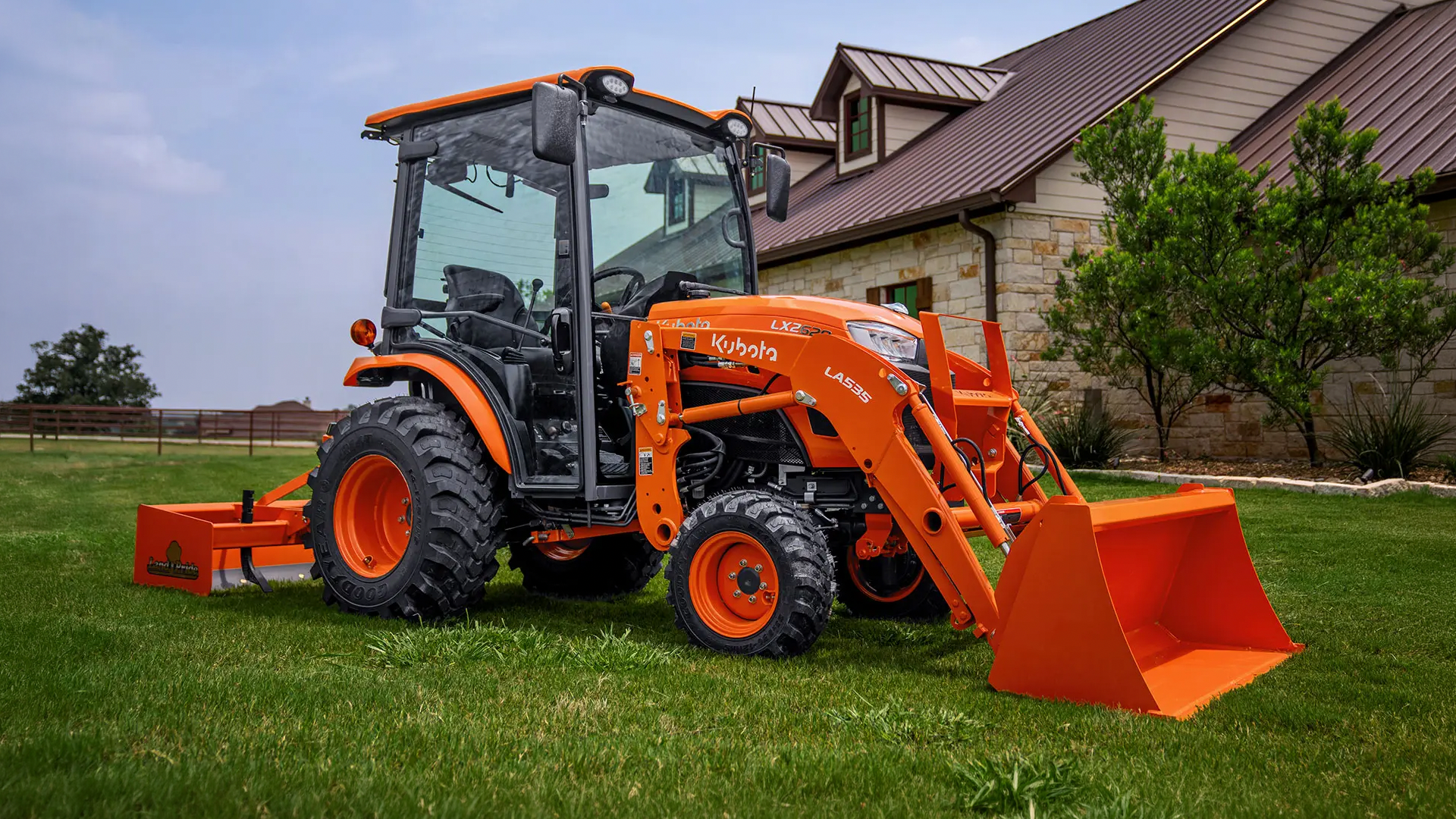
Best Kubota Compact Tractors for Temecula Ranch Property Temecula parcels are their own kind of tractor problem. Decomposed granite driveways that cut a channel every winter, real grade on almost every lot, grove and vineyard rows that set a hard width limit, and a fire season that turns brush clearing into a deadline. Here is how we size machines for it.
Quick Summary: Most Temecula Valley properties between two and ten acres land in the B, LX, or L class with a loader, a box blade, and a rotary cutter, and the three things that actually decide the machine are slope, row width, and how long your driveway is. Grade is the one people underestimate. A parcel in De Luz, off De Portola, or out toward Anza has enough pitch that four wheel drive, rear ballast, and R4 tires stop being options and start being the spec. If you have avocado, citrus, or vine rows, measure the narrowest row before you look at horsepower, because width will overrule everything else. Below: the four jobs these parcels generate, honest acreage to series sizing, the row width problem, the slope and ballast conversation, decomposed granite driveway maintenance, the order to buy implements in, and what to ask a local dealer.
Jump to what you came for
What Temecula owners walk in and ask.
Three questions come up in nearly every conversation at the Temecula store. All three get answered below.
"My driveway washes out every year."
Decomposed granite plus a winter storm equals a channel down the middle. A box blade with scarifiers fixes it in an afternoon, twice a year, forever.
"How much slope is too much?"
The honest answer is that it depends on ballast, tires, and what is in the bucket more than on the tractor's badge. This is the safety conversation worth having.
"Will it fit between my rows?"
Row spacing in a mature avocado or citrus grove decides the tractor before horsepower ever enters the conversation. Measure first, shop second.
The Four Jobs a Temecula Parcel Actually Generates
Every property is a little different, but after enough quotes across Temecula, Murrieta, Wildomar, Menifee, De Luz, and up the hill toward Anza and Aguanga, the work list stops surprising you. It comes down to four recurring jobs, and almost all of them are loader and ground engaging work rather than high horsepower PTO work.
| Job | When | What It Actually Needs |
|---|---|---|
| Rebuilding the decomposed granite driveway and access road | Before and after the rainy season | Box blade with scarifiers, machine weight |
| Clearing brush and grass for defensible space | Late spring into summer | Rotary cutter or flail, PTO horsepower |
| Grove, vineyard, and pasture chores | Year round | Narrow width, loader, low speed control |
| Dirt work: pads, drainage, fence lines, hauling | Project driven | Loader capacity, rear ballast, four wheel drive |
If you keep horses on the Wine Country side, add a fifth: manure and bedding handling, which is weekly and never stops. That job pushes people toward loader dump height and a bigger bucket rather than toward horsepower.
Working through sizing from scratch? Start with what size tractor do I need, then come back here for the local part.
Send us your acreage, your driveway length, and whether you have grade. That is usually enough to narrow it to two machines.
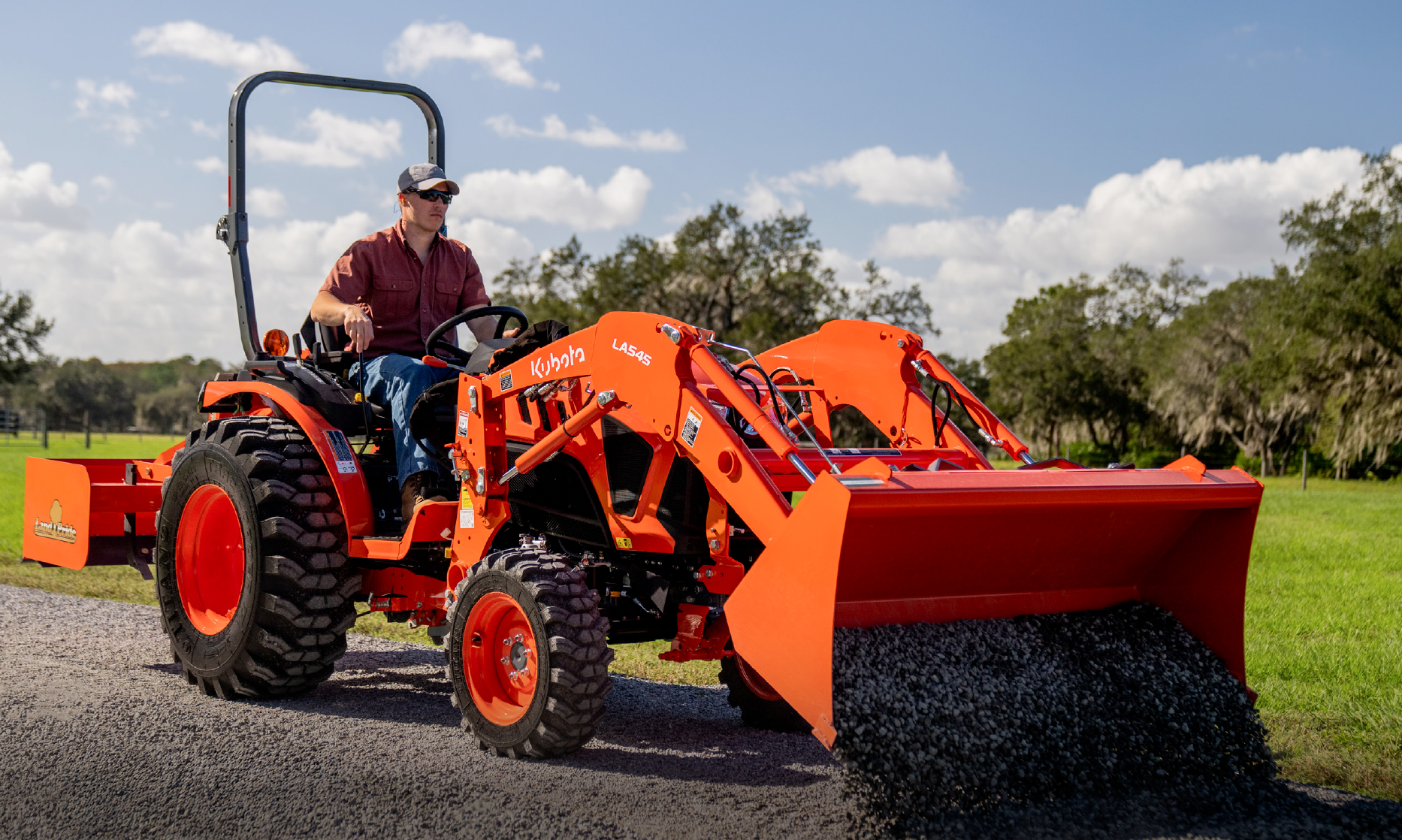
Acreage to Series: Honest Ranges, Not a Formula
Acreage is a starting point, not an answer. A flat five acres in Menifee and a five acre hillside in De Luz are two completely different machines. Use the table below as a first pass, then adjust up for slope and long driveways and adjust down for tight rows and narrow gates.
| Property | Kubota Series | Rough Horsepower | Why It Lands There |
|---|---|---|---|
| 1 to 2 acres, flat, short driveway, mostly tidying | BX Series | High teens to mid twenties | Narrow, easy to store, fine for light work |
| 2 to 5 acres, some grade, gravel or DG driveway | B Series | Low to mid twenties | More weight and ground clearance than a BX |
| 3 to 8 acres, mixed chores, wants comfort and a real loader | LX Series | Twenties into the low thirties | The sweet spot for a lot of Temecula parcels |
| 5 to 20 acres, real slope, brush cutting, long access road | L Series | Mid twenties to mid forties | Weight and PTO power for a five or six foot cutter |
| 20 acres and up, grove or vineyard production, hay | MX Series | Mid forties to low sixties | Wide implements, all day duty cycle |
Two adjustments matter more here than anywhere else. Long driveways push you up, because a heavier tractor cuts and carries decomposed granite better than a light one and you are not going to enjoy six passes when two would do. Tight rows and narrow gates push you down, and unlike horsepower, width is not something you can negotiate with once the tractor is on the property.
Tell us the acreage and the steepest part of the property and we will shortlist two machines that make sense.
Avocado, Citrus, and Vine Rows Decide the Tractor
This is the single most common way people buy the wrong machine in this valley. They size for horsepower, take delivery, and then discover the tractor will not get down a row in the grove without shearing branches or scraping a trellis wire. In De Luz and out toward Fallbrook there are avocado and citrus plantings that predate anyone's tractor shopping, and the rows are as narrow as they are. Wine Country vineyard rows are laid out on a grid that was designed around a specific machine footprint.
The fix is unglamorous. Go measure. Take a tape to the narrowest point of your narrowest row, at the height where the tractor's widest part sits, which is usually the rear tire stance or the loader bucket. Then measure your lowest branch or the lowest wire. Bring both numbers to the dealer and the conversation gets very short.
| Row Situation | What Usually Fits | Watch Out For |
|---|---|---|
| Mature avocado, canopy closed in, tight spacing | BX or a narrow B | Loader bucket width and mirrors, not just the tires |
| Citrus on traditional spacing | B or LX | Low branches catching the ROPS |
| Vineyard rows on standard spacing | LX or a narrow L | Trellis wires and end post turning room |
| Newer plantings on wide spacing | L Series | Turning room at the row ends, not the row itself |
| Open pasture, no rows | L or MX | Nothing. This is where you size for the work |
Bring us your row measurement and your lowest branch height and we will tell you exactly what fits.
Slope, Ballast, Tires, and Why People Regret Undersizing
Most of this valley has grade. Not dramatic mountain grade, but enough that a tractor behaves differently than it does on the flat, and enough that a loaded bucket held high changes the machine's center of gravity in a way that gets people hurt. If your property is in De Luz, along De Portola, up in the hills above Temecula, or out toward Anza and Aguanga, plan around the slope from the start rather than discovering it in month two.
Three things do the work here. Four wheel drive, because two wheel drive on a decomposed granite slope is an exercise in wheel spin. Rear ballast, either a ballast box on the three point or loaded rear tires, because ballast is what keeps the rear wheels planted and the steering and braking honest when the loader is full. And R4 industrial tires, which are the sensible middle ground between turf tires that will not grip and R1 ag lugs that tear up everything you drive across.
The undersizing regret is a slope story almost every time. A tractor that felt fine on the dealer lot feels light and skittish on a fifteen percent grade with a full bucket, and the owner ends up making three trips instead of one, or worse, keeps loading it anyway. If you have real grade, buy the weight.
The other local factor is heat and dust. Summer here is hot and the decomposed granite dust is relentless, and both go straight at the engine air filter and the radiator screen. Blow the screen out often in summer, check the primary air filter far more frequently than the manual's baseline interval suggests, and do not let the fins pack up. A cooling system full of DG dust is the most preventable service call we see.
Keeping horses too? The arena, footing, and manure side of the job is covered in our guide to the best tractor for horse property.
Come run one on the lot in Temecula before you decide. Bring your numbers and we will do the fit check together.
Decomposed Granite Driveways and Fire Season Clearing
These are the two jobs that put a calendar on your tractor purchase. One arrives with the winter rain and one arrives with the summer heat, and between them they justify the machine on most properties out here.
The driveway
Decomposed granite is cheap, drains reasonably, and looks right on a ranch property. It also moves. A season of rain running down a driveway with no crown will cut a channel straight down the middle, undercut the edges, and deposit half your surface at the bottom of the hill. Then the potholes start and the delivery truck driver starts complaining.
The tool is a box blade with scarifiers. Drop the scarifiers to break the crust, make passes that pull material back toward the center to rebuild crown, then float the box to smooth it. A rear blade angled to the side is useful for pulling the shoulders back in and for cutting a shallow drainage swale beside the road. Do it once in the fall before the rain and once in the spring after it, and the driveway stops being an annual expense.
Fire season
Out here a rotary cutter is a fire tool that happens to also mow. Defensible space around structures means keeping grass, mustard, and light brush knocked down through the dry months, and doing it on your own schedule instead of scrambling when an inspection notice shows up or the wind comes up in September. A tractor with a cutter turns a multi day hand crew job into an afternoon.
Be honest about what you are cutting, though. A rotary cutter behind a compact tractor eats grass and light brush all day. Heavy woody brush, mature chaparral, or a slope steep enough that you would not walk it comfortably is a different job, and the right answer there is a track loader with a brush cutter head or a hand crew, not a tractor you are trying to talk into something. A flail mower is worth considering if most of your clearing is close to structures and fence lines, since it leaves a finer, more evenly distributed cut and throws far less material.
Clearing more brush than a tractor should handle? Read our comparison of track loaders vs skid steers for the heavier end of the job.
Tell us your driveway length and how much brush you clear each year and we will spec the cutter and the box blade with the tractor.
What to Buy First, and What to Ask a Local Dealer
You do not need the whole catalog on day one. This is the order we would buy in for a typical Temecula Valley parcel, and the first three cover most of what the property will ask of you in the first year.
| Priority | Implement | What It Earns Its Keep On |
|---|---|---|
| 1 | Front loader with quick attach | Everything. Material, gravel, brush piles, fence posts |
| 2 | Box blade with scarifiers | The DG driveway, pads, spreading material |
| 3 | Rotary cutter | Defensible space, pasture, weed control |
| 4 | Ballast box or filled rear tires | Safety and traction on grade with a loaded bucket |
| 5 | Rear blade | Shoulders, drainage swales, snow if you are up at elevation |
| 6 | Pallet forks | Hay, bagged material, fencing, deliveries |
| 7 | Post hole digger | Fencing, trees, shade structures |
| 8 | Flail mower | Finer clearing close to structures and fence lines |
What to ask before you sign
Buying local matters more on equipment than on almost anything else, because the relationship starts rather than ends at delivery. A few questions separate a dealer who will be useful from one who will not.
Our Temecula store is at 28374 Felix Valdez Ave and the number is (951) 517-2979. If you want to bring a photo of the driveway and a tape measurement of your narrowest row, that is genuinely the fastest way to get to an answer.
More on the store, hours, and what we keep on the lot: Kubota Temecula. Browse the full lineup on the compact tractors pillar page.
Send us your job list and your measurements and we will come back with two machines and an implement package that fits the budget.
Questions We Get at the Temecula Store
Honest answers. No script.
What size tractor do I need for a 5 acre property in Temecula?
On a typical five acre Temecula parcel with a decomposed granite driveway and some grade, most buyers land in the B or LX class, roughly the mid twenties to low thirties horsepower, with a loader and a box blade. A BX can work if the parcel is flat and the driveway is short. If you also run a rotary cutter through brush every spring, step up to an L.
Do I need four wheel drive on a Temecula hillside property?
Yes, and it is not really optional here. Most parcels in De Luz, Wine Country, and out toward Anza and Aguanga have real grade, and a loaded bucket on a slope with two wheel drive is how people get stuck or worse. Four wheel drive, rear ballast, and R4 tires are the standard setup we spec for this area.
What tractor width fits between avocado, citrus, or vineyard rows?
Measure your narrowest row and your lowest branch before you shop, because the row spacing decides the tractor and not the other way around. Tight mature rows usually push people to a sub compact or a narrow compact. Newer plantings on wider spacing can take an L class machine. Bring us the row measurement and we will tell you what physically fits.
How do I keep a decomposed granite driveway from washing out every winter?
A box blade with scarifiers, pulled once or twice a year before and after the rainy season, is the tool that does it. You are rebuilding crown so water sheds to the sides instead of running down the middle and cutting a channel. A rear blade helps on the shoulders. Doing it yourself twice a year costs less than a single grading service call.
Can a compact tractor handle defensible space clearing for fire season?
For grass, light brush, and mustard, yes. A rotary cutter on a compact tractor clears a lot of ground fast, and a flail gives you a finer cut closer to structures. For heavy woody brush or steep untracked hillside, a compact tractor is the wrong tool and a track loader with a brush cutter or a hand crew is the right one. Be honest about what you are actually cutting.
Is there a Kubota dealer in Temecula, and what about financing?
Yes. PDQ Equipment is at 28374 Felix Valdez Ave in Temecula and you can reach the store at (951) 517-2979. Kubota Credit runs financing programs on qualifying new models, and if the property operates as a business, Section 179 may change the after tax cost. Programs change through the year, so ask what is running the week you buy and talk to your tax professional about the deduction side.
Still have a question this guide did not cover? Ask a human. That is what we are here for.
Your Machine. Your Call.
You know your work better than any spec sheet does. Bring us the jobs and we'll match the machine, with real numbers and zero pressure.
*Subject to credit approval through Kubota Credit Corporation. Terms and availability vary. Consult your tax professional regarding Section 179.