

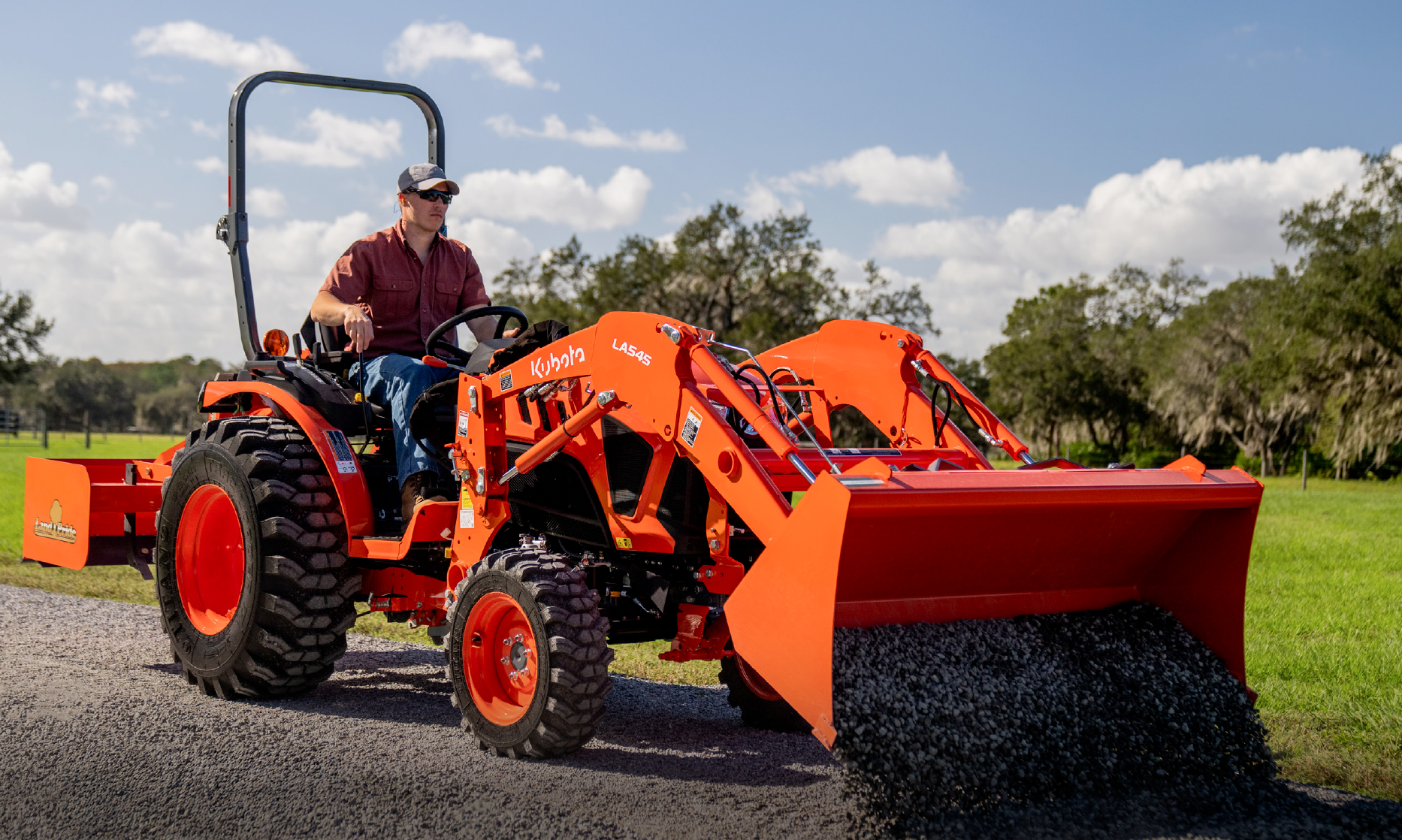
The Implements You Actually Buy First Box blade, rotary cutter, grapple, quick hitch, and the Land Pride order almost every compact tractor owner ends up in anyway
Disclosure before anything else. We sell Land Pride implements, we sell the Kubota tractors they hang off, and we rent both. Renting is the part that matters, because we pay for what comes back broken.
So read this with the obvious suspicion. Here is the other half, up front. Most compact tractor owners buy too many implements and use three of them. We know, because we sell the ones that get used and the ones that end up leaned against a fence with a wasp nest in the gearbox. There is a section below on both.
The useful part is that the order is consistent. Five acres in Temecula, a horse setup in North County, a hillside lot above Sun Valley, everyone lands on the same list in the same sequence. Box blade. Rotary cutter. Grapple. Then whatever the dirt demands.
Nobody budgets for implements. They budget for the tractor, then discover the implements are a second purchase with their own four figure invoices attached.
Jump to what you came for
The Order Almost Everyone Buys In
This is not a ranking. It is what we watch happen from the first delivery to about year three, stable enough to be a little funny.
| Implement | Where it lands | Honest read |
|---|---|---|
| Box blade | First, usually same day | The right call. Drives, pads, dragging out ruts after a storm cycle. Earns its keep the first weekend. |
| Rotary cutter | Second, before fire season | Also right on acreage. Weed abatement is not optional here, and the alternative is paying a crew. |
| Front grapple | Third, after the first brush pile | Bought later than it should be. Owners say they wanted it day one, because moving material by hand is the bottleneck. |
| Quick hitch | Fourth, sometimes never | Wrong position in the order. Cheapest thing here and the reason the others get used. |
| Pallet forks | Fifth, and correctly | No hydraulics, no PTO, nothing to break. Feed, posts, block, they pay off fast. |
| Post hole digger | Bought early, used twice | The classic. Buy an auger to set a fence, then it sits four years. Decomposed granite and caliche eat the bit. |
That is our read from one yard in Southern California, not a survey. Somebody working row crop would rewrite it.
The Land Pride catalogue is deep enough to be a problem on its own. Browse it on our attachments page after you decide what you need. Catalogues are how people end up owning a disc harrow.

Why the Box Blade Comes First
Because dirt moves and nobody warns you how much. A gravel drive above Escondido does not stay where you put it. One wet cycle and half of it sits in a berm at the bottom of the grade. A box blade fixes that in an afternoon, every year.
The box blade is the only implement owners describe as fun. Make of that what you will.

Rotary Cutter or Flail Mower
This is the one people get wrong, and both are real purchases, so it is expensive. They look like the same job and they are not.
| Rotary cutter | Flail mower | |
|---|---|---|
| What it handles | Wins. Heavy brush, saplings, rank weeds. Built to hit things. | Grass, light brush, overgrown pasture. It does not want to meet a stump. |
| Finish quality | Rough. Knocks material down and leaves windrows behind it. | Wins. Cuts fine and spreads evenly. Looks maintained rather than flattened. |
| What it throws | Rocks, and far. A real hazard near buildings, cars, fences and people. | Wins. Throws down, not out. This is why it exists for roadsides and fence lines. |
| Width per horsepower | Wins. More cutting width for the same PTO horsepower. | Heavier and hungrier. The same tractor buys you a narrower machine. |
| Purchase cost | Wins. Meaningfully less for comparable width. | The premium is real, plus dozens of knives to replace. It is why most people never buy one. |
No dollar figures here on purpose. Implement pricing moves, and anything we printed would be wrong by the time you read it. Call any branch for a current number.
On horse property the flail question settles itself, along with four other implement decisions. See tractors for horse property.
What Your Tractor Can Actually Lift and Turn
Most implement returns are not a defect. They are somebody buying a tool their tractor cannot carry, cannot spin, or cannot feed enough power to. Four numbers decide it, and all four are on spec sheets you already have.
Read the implement's rating sheet once against your tractor's. Four minutes, and it prevents most of what goes wrong above.
Which Tractor You Are Actually Standing On
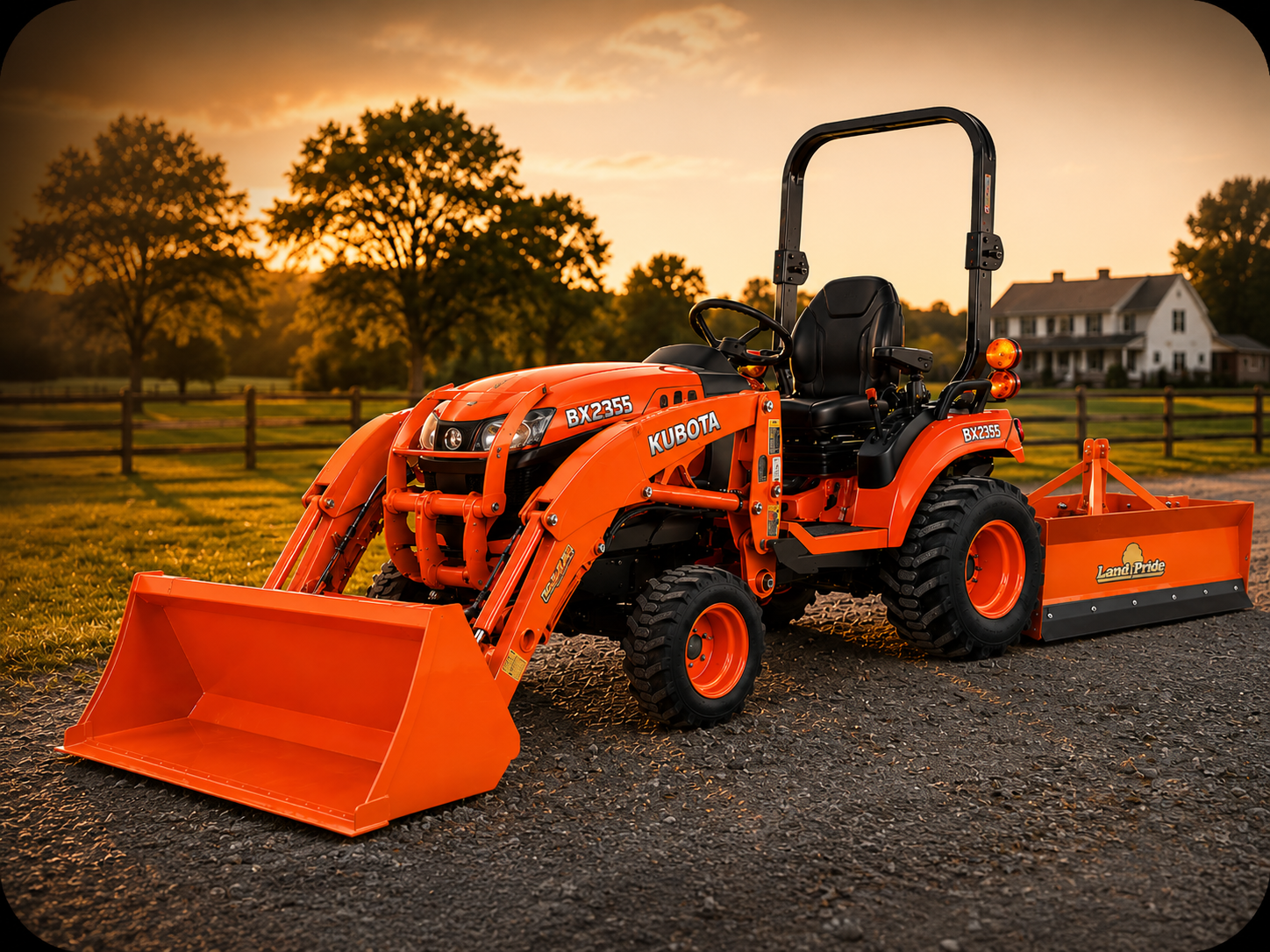
BX class, one to three acres
Mower deck, small box blade, pallet forks, light grapple. Narrow implements inside its lift rating and track width. This class gets ruined by people hanging utility tractor implements on it.

B and LX class, the volume answer
The class this guide is written for. Full size box blade, a rotary cutter sized to its PTO rating, a real grapple, a quick hitch. Five acres in the Inland Empire or North County, this is your tractor.

Backhoe on the back, and the tradeoff
A backhoe turns the tractor into a digging machine and the three point hitch into a parking spot. Swapping it off to run a cutter is a job, not a task. Own it if you dig monthly, rent if you dig twice a year.
Sizing is a separate argument. Start with the right tractor for five acres, or real ground in Kubota tractors on a Temecula ranch. The lineup is on the compact tractor page.
The Short Version
Box blade, quick hitch, rotary cutter. In that order, in year one. That kit handles what almost every Southern California property generates.
Front grapple, and you should have bought it already. It is the implement owners say changed how much they use the tractor at all.
Flail mower. Pay the premium. A rotary cutter throws rocks and that bill arrives all at once.
Rent the implement. Do not buy an auger to dig eleven holes. And if you are digging more than mowing, rent a mini excavator instead, because it digs better than any tractor backhoe.
Bring the model number. We will check the lift rating and the PTO range against the implement before anything goes on a trailer.
Talk to someone who runs theseThe Quick Hitch, the Grapple, and What Ours Have Cost Us
Two implements earn their own section. One is the cheapest thing on the list.
Most of What You Just Read Is Secondary
Time to undercut the article. The implement comparison above is the least important thing on this page.
Land Pride, Woods, Frontier, Bush Hog and half a dozen others all build a box blade that will outlive your interest in grading. The differences are small and none of them decides whether you are happy in five years.
What decides it is whether the implement fits your tractor, whether you can get a blade or a gearbox without a three week wait, and whether anybody picks up the phone. Local problems, nothing to do with paint colour.
Buying the right implement for the wrong tractor is the most common mistake we see, and no comparison chart on the internet will catch it for you.
So skip the forum threads and ask these five questions of whoever you buy from:
- What is the PTO horsepower range on this implement, and where does my tractor sit inside it?
- What is my three point lift capacity behind the lift points, and what does this implement weigh?
- Do you stock the wear parts, blades, shear bolts, gearboxes, driveline components, or is everything ordered in?
- Will this mate to a quick hitch, and if not, what will?
- Can I rent this one before I buy it?
That last question sorts dealers. Three branches, Sun Valley in Los Angeles, Temecula, and Escondido in San Diego, same family since 1952. Ask us all five, then ask whoever else you are considering.
Straight Answers
What attachments do I need for a compact tractor?
Three cover most of the work. A box blade for driveways, pads and grading, a rotary cutter for weeds and brush, and a front grapple for material you would otherwise move by hand. Add pallet forks if you move anything on a pallet, and a quick hitch so swapping takes a minute instead of fifteen. Buy anything past that to solve a specific problem, after the problem shows up.
What should be the first implement I buy for a compact tractor?
A box blade, in almost every case. Gravel drives wash out, pads settle, ruts appear after every wet cycle, and a box blade fixes all of it. It is also useful the first weekend, which is not true of most implements. On hard Southern California ground the scarifier shanks matter more than the blade, because decomposed granite and caliche pack down and a blade dragged across the surface does nothing.
Should I get a rotary cutter or a flail mower?
Rotary cutter for heavy brush, saplings and fire season abatement. It takes rougher material, gives more cutting width for the same PTO horsepower, costs less and is simpler to maintain. Flail mower for a finished cut and anywhere the throw is a hazard, near vehicles, fences or a neighbor's property, because a flail throws material down instead of out. Heavier than either handles and you are into mulcher territory, which is a different machine.
Will Land Pride implements fit my Kubota tractor?
Generally yes, and Land Pride is the line we stock alongside Kubota tractors for that reason. Fit still comes down to three checks. Confirm the three point hitch category matches, confirm your PTO horsepower sits inside the implement's rated range rather than at the bottom of it, and confirm your lift capacity handles the implement's weight at distance behind the lift points. Bring your model number and we will check all three.
What size box blade do I need?
Match your rear tire track or go slightly wider, so the blade covers the ruts your own tires make. Narrower and you spend the day chasing tire marks. Much wider and you are lifting and turning weight for nothing. Weight helps a box blade cut, but the three point lift rating is a hard limit, so check the implement weight against your tractor before choosing a width.
Is a quick hitch worth it on a compact tractor?
It is the best value on the list. Connecting a three point implement by hand takes ten to fifteen minutes of backing up, climbing off, wrestling the lower arms and setting the top link. A quick hitch turns that into a back up and a lever. The effect is that you swap implements for short jobs instead of putting them off, so the implements you already paid for get used. Check compatibility first.
Yes, This Was an Ad
You just read an implement dealer explain which implements to buy. You saw it coming in the first paragraph and read on anyway, so we will skip the pitch.
Here is what the ad is for. Bring your model number to any branch and we will put the implement rating sheet next to your tractor's spec sheet. If your tractor cannot carry what you came in for, we will say so, because a returned implement costs us more than the sale was worth.
If the answer is rent it, we will say that too. The customer who rents an auger for one fence run buys a grapple from us two years later.
We have been here since 1952 by being the yard people call back, not the yard that moved one more box blade this quarter.