

Scissor Lift vs. Boom Lift: Which Gets Your Crew Where They Need to Go? Straight up or up and over, slab or dirt, and why the cheaper lift is the right answer more often than the rental desk would like
Disclosure. We rent both kinds of lift, and a boom usually rents for more than a scissor. So it would pay us to talk you into the boom. We are going to try not to.
Short answer: Rent a scissor lift when the work is directly above a spot you can drive the machine to, on firm, fairly level ground, and you want a big platform for people and material. Rent a boom lift when something is in the way (a planter, a canopy, a slope, a roofline) and you need to reach up and out over it. If you can get the scissor under the work, the scissor almost always wins on cost, stability and deck space.
The question is never how high. It is what is between you and the work.
Most people call the rental counter with a height. "I need to get to 30 feet." That is half the question. A 30 foot job on a warehouse slab and a 30 foot job over parked cars and a hedge are two different machines.
Jump to what you came for
Straight Up vs. Up and Over
Both are aerial work platforms (the industry now calls them MEWPs, mobile elevating work platforms). The difference is how the platform gets where it is going.
Scissor lifts go vertical
A scissor lift raises a wide, flat platform straight up on a folding crisscross frame. It does not swing, reach or lean. Many models have a roll-out deck extension that slides a few feet past one end, which helps with a little overhang, but that is the extent of the horizontal reach. Where the base is, the work is.
Boom lifts go up and out
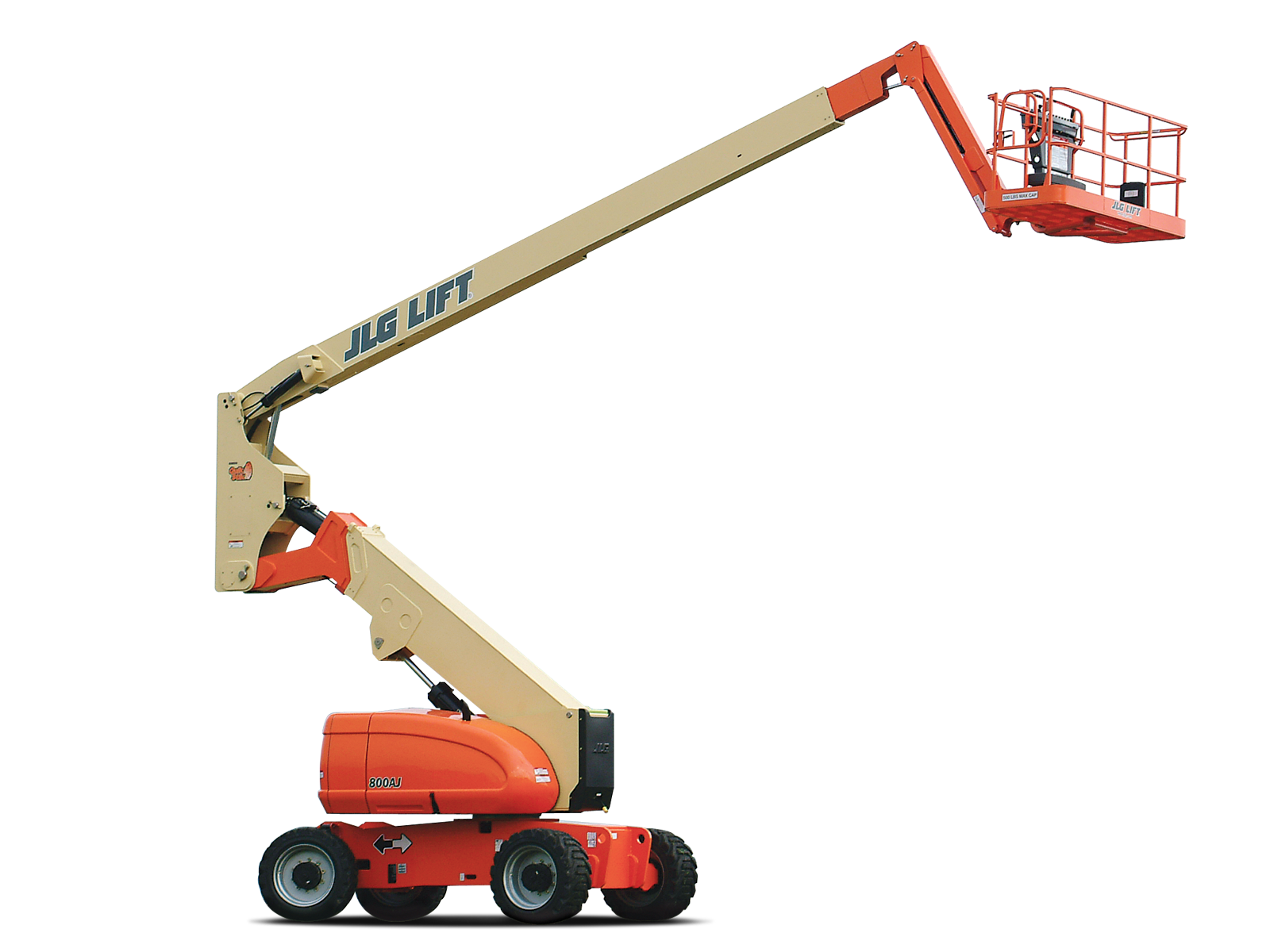
A boom lift puts a smaller platform, often called a basket or bucket, on the end of an arm mounted to a turntable. The turntable rotates, the arm raises and extends, and the platform can end up well to the side of the machine. That is the whole reason to pay for one.
Reach, Obstacles and the Height Number Everyone Gets Wrong
Measure the obstacle before you measure the height.
Platform height is not working height
Lift specs list platform height, meaning how high the floor of the platform goes. Working height is where a person standing on it can reach, and the common rule of thumb is platform height plus about six feet. So a 26 foot scissor puts hands around 32 feet. Confirm which number a spec sheet is quoting.
Horizontal outreach is its own number
A boom rated to a certain height does not reach that far sideways at the same time. Outreach shrinks as you go higher. Ask for the range chart for the exact unit and lay your job on it: where the base parks, how high the work is, how far out it sits.
A worked example
Say you are replacing a light fixture 22 feet up on the front of a two story building in Riverside County. Directly under it is a 10 foot deep planter bed you are not allowed to drive on. A scissor cannot get under the fixture, so it is out. An articulating boom parked at the curb can reach up and out over the planter. The height alone said scissor. The planter said boom.
Flip it. Same fixture over a flat concrete walkway. A scissor drives right up and you skip the boom rate. The boring answer is usually the right one.
Platform Size and Capacity
This is where scissors quietly beat booms. A scissor deck is long and wide. A boom basket holds one or two people and hand tools. Hauling up drywall, duct or conduit? The scissor is a work floor and the boom is a phone booth.
Read the capacity decal, every time
Every lift has a rated platform capacity on a decal and in the manual, and it includes people, tools and materials together. Some machines have a lower rating with the deck extension out or the boom fully extended. Do not assume two lifts of the same height carry the same load. Add up the crew (with their gear on) and everything going up, and leave margin.
| Factor | Scissor lift | Boom lift |
|---|---|---|
| Reach over obstacles | None, beyond a short deck extension | Yes, the whole point |
| Platform size | Large, room for crew and material | Small basket |
| Typical rental rate at a similar height | Usually lower | Usually higher |
| Fits indoors on a slab | Narrow electric units fit doorways | Narrow and electric booms exist, still bulkier |
| Uneven or sloped ground | Rough terrain models handle some | 4x4 and crawler units handle more |
| Maximum height | Lower ceiling | Goes much higher |
Ceiling work across a big room, overhead electrical runs, painting a long wall: anywhere you work a long line at one height, the scissor is plainly better.
Ground Conditions and Power Source
A lift is only as good as the dirt under it.
Slab work: electric
Electric scissors and electric booms run on batteries, make no exhaust and are usually fitted with non-marking tires. They are the default for indoor work, finished floors and anywhere fumes are a problem. They are built for firm, smooth, level surfaces. Some small electric scissors are rated for indoor use only, with no allowance for wind at all, so check the decal before you take one outside.
Dirt, gravel and slopes: rough terrain
Rough terrain scissors and 4x4 booms have engines (gas, propane, diesel or hybrid depending on the unit), bigger tires and more ground clearance. On a graded pad in the Inland Empire or a hillside lot in San Diego County, that is usually what you need. They still have slope limits in the manual. Rough terrain does not mean any terrain.
Heat, dust and batteries
Summer in the valleys of LA County and Riverside County is hard on everything. Batteries run down faster on long hot days and dust gets into everything. Charge electric units every night and ask what run time to expect from the specific unit.
Narrow Units, Crawlers and Towables
The best lift is useless if it cannot get to the job. Backyards in older LA County neighborhoods, hillside side yards in Escondido. Measure first.
Narrow scissors
Electric scissors come in widths from about 30 inches up to the high 40s. The narrow ones are built for doorways and aisles. Measure the door, the hallway and every turn.
Narrow and crawler booms
Narrow articulating booms in the 30 to 40 foot range exist for exactly this problem. Crawler booms ride on tracks, which can help on soft ground, though they are not a cure for every hillside.
Towable booms
A towable boom rides on its own trailer and hitches to a truck. You set it up on outriggers at the job. It suits someone who has the truck and wants to skip delivery, but the truck, hitch and driver all have to be up to the weight. Ask for the towing weight of the unit, and see our mini excavator towing guide for the California towing questions.
Building an ADU on a tight lot? The ADU equipment guide covers the rest of the machine list.
Training, Fall Protection and Overhead Lines
We are a rental company, not your safety program. Here is the general shape of it.
Operators need training
Employers are expected to make sure operators are trained and familiar with the specific machine, and the manufacturer's manual and decals set the limits. Employers should check with their safety person or insurer. Homeowners: read the manual and ask for a walk-through of the controls before you go up.
Fall protection is different on each type
On boom lifts, wearing a harness with a short lanyard clipped to the platform's anchor point is standard practice and widely required. On scissor lifts, the guardrails are the primary fall protection, and whether anything more is needed depends on the manufacturer, the site rules and the employer's program. Either way, keep both feet on the platform floor.
Overhead power lines
Booms reach into places people forget have wires. Stay well clear of power lines. A commonly cited minimum is 10 feet for lower voltage lines and more for higher voltage, and the utility can tell you what is on the pole. If the work is close to lines, call the utility before you rent.
Wind
Santa Ana winds are a lift problem, not just a fire weather headline. Lifts have a maximum rated wind speed, or none for indoor-only units. Check the decal and the forecast, and come down when the gusts pick up.
Renting a Lift Without Surprises
Once you know which lift, the rental part is mostly ordinary.
Day, week and hour meters
PDQ's posted rental policies say a day rate covers 24 hours in your possession with up to 8 hours of use, a week rate covers 7 consecutive days with up to 40 hours, and a 4-week rate covers 4 consecutive weeks with up to 160 hours. Hour-metered items are billed against those hours, and use past 8 hours in a day is charged as overtime. The signed rental contract is what governs. If the job is longer than three or four days, run the math in our daily vs weekly vs monthly guide before booking by the day.
Damage waiver and insurance
PDQ's posted policies list a damage waiver at 15 percent of the rental rate unless an approved certificate of insurance is on file, and the rental contract spells out the exceptions. Read what is covered, and use our rental damage coverage guide for the questions to ask your insurance agent.
What to have ready
The posted policies require a valid California driver's license for every rental, payment when the item is picked up, and a deposit that varies by item. If this is your first rental, our first-time rental guide covers the rest. For delivery fees, cancellation or swapping a scissor for a boom mid-job, ask, and read the rental policies page. The full lift lineup is in the rentals catalog.
And if what you really need is to lift pallets of material to a second floor rather than people, that is a different machine. Read telehandler vs. forklift before you rent a lift to do a forklift's job.
The Short Version
Start with a scissor
If you can drive under the work on firm, level ground, the scissor is cheaper, steadier and holds more.
Boom when something is in the way
Planters, slopes, rooflines and machinery are why booms exist. Measure the obstacle, then the height.
Match the ground and the power
Electric for slabs and indoors. Rough terrain and 4x4 for dirt, gravel and graded pads.
Read the decal
Capacity, wind rating and slope limits are on the machine. They beat anything on this page.
Six Questions to Answer Before You Call
- How high is the work, and is that the platform height or where hands need to reach?
- Can the machine park directly under the work, or is something in the way?
- How many people and how much material go up at once?
- Is the ground a finished slab, packed base, dirt or a slope, and is it dry?
- What is the narrowest gate, door or turn on the way in?
- Who is operating it, and have they been trained on this type of lift?
Straight Answers
What is the difference between a scissor lift and a boom lift?
A scissor lift raises a large platform straight up and has to be parked directly under the work. A boom lift puts a smaller platform on an arm that can rotate and reach up and out over obstacles.
Is a scissor lift cheaper to rent than a boom lift?
Usually, at a similar height, yes. If a scissor can reach the work from directly underneath, it is often the cheaper choice.
Do you need a harness on a scissor lift?
On scissor lifts the guardrails are the primary fall protection, and whether a harness is also required depends on the manufacturer, site rules and the employer's safety program. On boom lifts a harness and lanyard clipped to the platform anchor is standard practice.
Can you use a scissor lift on grass or dirt?
Not a slab electric scissor. Rough terrain scissor lifts are built for firm dirt and gravel within the slope limits in the manual.
What is the difference between platform height and working height?
Platform height is how high the floor of the platform rises. Working height is where a person standing on it can reach, commonly figured as platform height plus about six feet.
Articulating or telescopic boom lift, which one do I need?
An articulating boom bends up and over obstacles like walls and rooflines. A telescopic boom is a straight arm that generally gives more horizontal reach in open areas.
Fine, You Caught Us Selling Something
A long page about lifts from a company that rents lifts. We will not pretend this was a public service announcement.
Call with the height, what is underneath the work, the ground and the narrowest gate. We will tell you which lift fits, and if the answer is the smaller scissor instead of the bigger boom, that is what we will say.
We have been at this since 1952. The cheapest lift is the one that does the job on the first delivery.