

Telehandler vs. Forklift: Which Fits Your Jobsite? Up, or up and out, and the load chart nobody reads
Disclosure. We rent telehandlers and forklifts, so either answer pays us. That makes us fairly relaxed about which one you pick, and fairly fussy that you pick the one that will not end up on its side.
Short answer: Rent a telehandler when the load has to go up and out, over a wall, onto a roof or a second-floor deck, or across a trench the machine cannot drive over. Rent a forklift when the load only goes up and down on reasonably firm, level ground: a rough terrain forklift for dirt and gravel, a warehouse forklift for concrete slabs. Choose by reach and ground conditions, not by the biggest number on the spec sheet.
A forklift lifts. A telehandler lifts and reaches. Reach is where the money and the risk both live.
People use the word "forklift" for at least three different machines, and our own catalog does not help: we list telehandlers as "reach forklifts." So first, definitions.
Jump to what you came for
Three Machines People Call a Forklift
They look related. They are not interchangeable.
The warehouse forklift
Small, solid or cushion style tires, a vertical mast, built for smooth concrete. Put it on dirt and it gets stuck or bounces the load off the forks. If your site has not been paved yet, this is not your machine.
The rough terrain vertical mast forklift
Same basic idea, a mast that lifts straight up, but with big pneumatic tires and more ground clearance. It handles a graded pad, gravel and packed dirt far better. It lifts high, but only straight up. It cannot reach over anything. If the pallet needs to land two feet past a wall, you are driving the forklift into the wall. Our catalog lists a 6,000 lb unit.
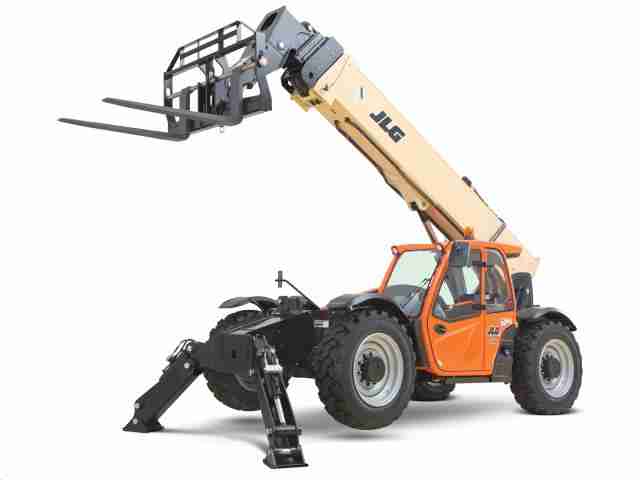
The telehandler
A telescopic boom on a wheeled chassis, often with all-wheel drive. It lifts up and pushes the load out. That lets it set trusses or put roofing on a second story while the machine stays on the ground. Our catalog lists these as reach forklifts, from a compact 13 foot, 3,000 lb unit up to an 80 foot rotating model in the 9,000 to 13,000 lb class.
Height Is Easy. Reach Is the Hard Part.
The capacity on the side of a telehandler is the best case, not the everyday case.
A telehandler rated at, say, 10,000 lb can usually lift that much only with the boom close to the machine. As you extend the boom and lower the angle to reach out, the safe capacity drops. Sometimes it drops a lot.
Read the load chart, every time
Every telehandler has a load chart in the cab that shows capacity by boom angle and extension. Many newer units also have a load management system. Treat it as a backstop, not a plan. The chart for the exact machine and attachment you rented is the one that counts, so read it before the first lift, not after the back tires get light.
Work backward from the drop point
Do not ask "how tall is the building." Ask: how high is the drop point, how far is it from where the machine can actually park, and what does the heaviest single pick weigh? Measure both before you call.
A worked example, round numbers
Hypothetical: 2,500 lb pallets of tile go on a second-floor deck. The deck edge is 14 feet up, but a planter and a trench keep the machine 18 feet back from the wall. A vertical mast forklift is out, because it cannot reach. A small telehandler might be rated well above 2,500 lb in the brochure and still be under 2,500 lb at that reach. A unit with capacity to spare at that point on the chart is the safer rental.
Your Ground Decides More Than You Do
The machine has to stand somewhere. In Southern California that somewhere is often loose fill, decomposed granite, a fresh pad, or a driveway that was never meant to carry a loaded machine.
Finished slab or asphalt
A warehouse forklift is happy here and usually the cheapest, smallest option. A telehandler works on pavement too, but it is a lot of machine to bring indoors.
Graded dirt, gravel and DG
Rough terrain forklift or telehandler. Pneumatic tires and ground clearance matter. After a rain, fresh fill in Riverside County or San Diego County can turn to mush fast. Soft ground under one tire tilts the whole machine.
Hillsides and cross slopes
Many telehandlers have frame leveling (sometimes called sway) to level the chassis on modest side slopes, and larger or rotating units may use outriggers or stabilizers. Those features have manufacturer limits. If the only place to park is a slope, ask the rental desk before you book what that particular machine allows.
Tight backyard access
Neither a telehandler nor a forklift fits through a 4 foot gate. For those jobs, a compact track loader with pallet forks often wins, which we cover below. Our ADU equipment guide goes deeper on backyard access.
Telehandler vs. Forklift, Factor by Factor
| Factor | Warehouse forklift | Rough terrain forklift | Telehandler |
|---|---|---|---|
| Reach over a wall or trench | None | None | Yes, that is the point |
| Dirt, gravel, graded pads | Poor | Good | Good |
| Indoor slab work | Best | Possible, check size | Usually too big |
| Capacity stays the same as you go up | Closer to it | Closer to it | Drops with reach |
| Attachments beyond forks | Limited | Limited | Most options |
| Footprint and turning | Smallest | Medium | Largest |
| Typical rental cost | Lowest | Middle | Highest, rising fast with size |
Read the table this way: the telehandler wins on flexibility and loses on size and cost. If your job never needs reach, you are paying for a boom you will not use.
When it is a lift question, not a load question
If what you really need is people working at height, not material, look at aerial lifts instead. Our scissor lift vs. boom lift guide covers that side. Some telehandlers accept a manufacturer-approved work platform. Ask; do not improvise.
Attachments, and the Machine You May Already Have
Forks are the default. Telehandlers can take more, which is a big part of why contractors like them.
You might not need either
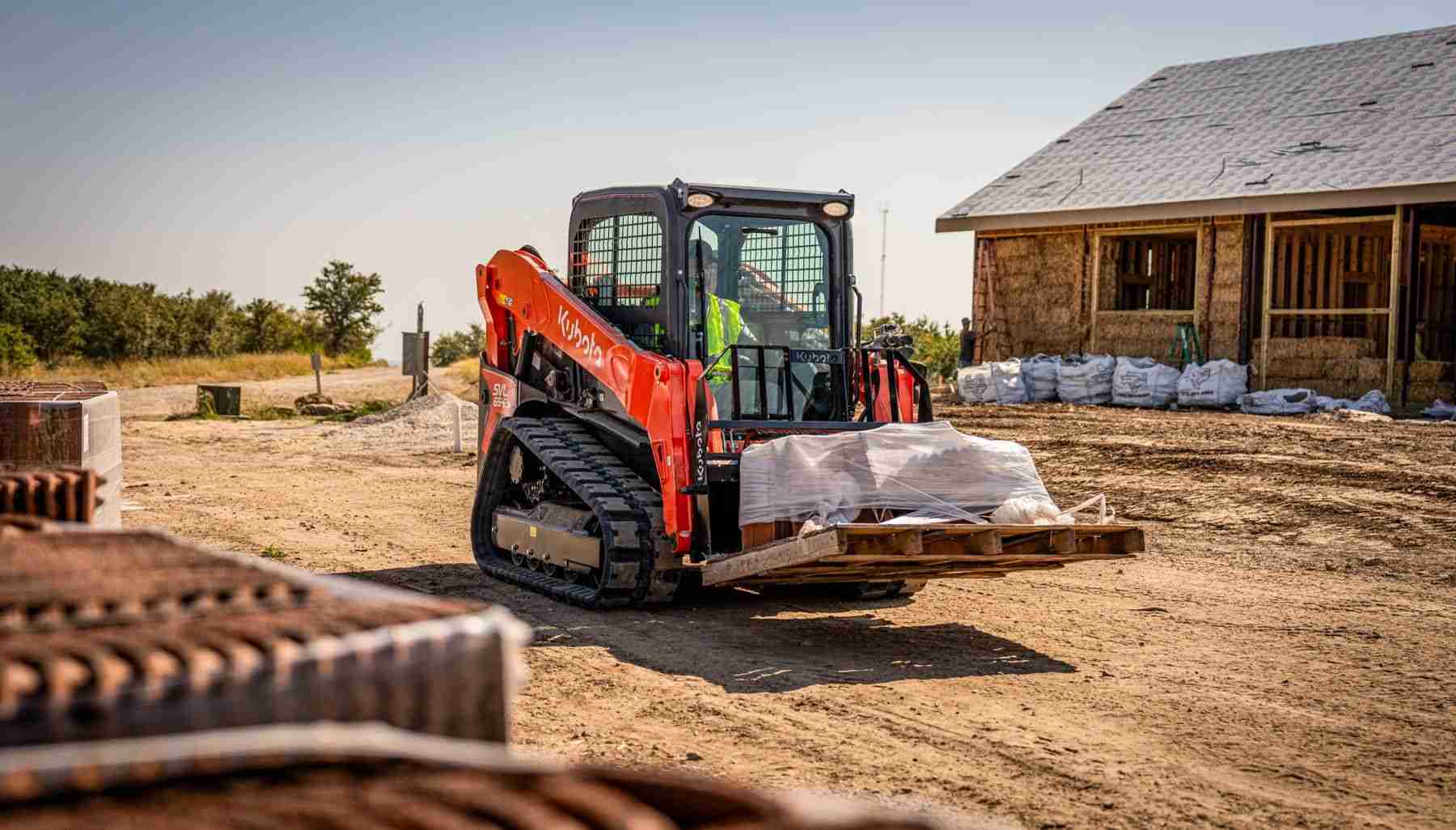
Look at the photo at the top of this page. That is a compact track loader with pallet forks. If you are moving pallets across a yard at ground level, a loader or skid steer with forks may do the job and fit through a smaller gate. It will not put anything on a second floor. Our compact track loader guide and skid steer attachments guide cover that route.
Or a material lift
For lifting ductwork, pipe or a single heavy fixture into place indoors, a material lift (our catalog lists 12, 18 and 24 foot units) can be the smaller, cheaper answer.
Renting One: What Actually Affects Your Bill
The machine choice drives the rate. The rental terms drive the surprises. Here is what PDQ's posted rental policies say, and the signed rental contract is what governs.
Day, week and 4-week rates
PDQ's posted rental policies say a day rate is 24 hours in your possession with up to 8 hours of use, a week rate is 7 consecutive days with up to 40 hours, and a 4-week rate is 4 consecutive weeks with up to 160 hours. Hour-metered items are based on 8 hours a day, and use over 8 hours a day is charged as overtime at 1.5 times the regular rate up to 16 hours a day, and 2 times the regular rate up to 24. Our daily vs. weekly vs. monthly rate guide walks through the math.
Damage waiver and insurance
The posted policies list a damage waiver at 15% of the rental rate unless an approved certificate of insurance is on file. The contract lists exceptions. Before you rely on either one for a big reach machine, read our rental damage coverage vs. insurance guide and ask your agent the questions in it.
ID, payment and delivery
A valid California driver's license is required, payment is due at pickup, and deposits vary by item. Delivery and pickup are available, with rates that vary by equipment type and location. On a delivered rental, the clock stops when you call it off rent and get a termination number, and the machine is still your responsibility until it is picked up. For first-timers, our guide to renting equipment for the first time covers what to bring. Anything else is a question for the counter and the rental policies page. Also worth a look: 7 costs to check on a rental quote.
Who Is Driving It Matters More Than What It Is
Forklifts and telehandlers are both powered industrial trucks in the eyes of most safety programs, and operators are generally expected to be trained and evaluated on the type of machine they run. Being good on a warehouse forklift does not make someone good on a 56 foot telehandler.
What to check before day one
Make sure your operator has training for the specific type of machine. Have them read the manual and load chart for the exact unit, and walk the path for overhead power lines before the machine arrives. We are a rental company, not your safety program, and we will not pretend otherwise.
Size it to the job, not the ego
The catalog runs from small reach forklifts around 13 and 19 feet up through 34, 43, 54 to 56, 75 and 80 foot rotating units. Most residential and light commercial jobs in Los Angeles County, Riverside County and San Diego County never need the top end. Bigger is heavier, harder to place and costs more every day. Rent the smallest one that handles your heaviest pick at your longest reach, with margin on the chart.
The Short Version
Need reach? Telehandler.
If the load goes over a wall, trench or edge, a telehandler is the only machine on this list that can do it.
Straight up on dirt? Rough terrain forklift.
Big tires, simpler, usually cheaper. It lifts high but cannot reach out.
Slab or warehouse? Warehouse forklift.
Smallest and cheapest. Keep it on pavement and it will be fine.
Read the chart, not the decal
Telehandler capacity drops as the boom extends. Size it for your heaviest pick at your longest reach.
Questions to Answer Before You Call
- What is the heaviest single load, including pallet and packaging?
- How high is the drop point, and how far is it from where the machine can park?
- What is the ground: slab, asphalt, compacted pad, loose fill or slope?
- How wide is the access, and are there overhead lines or low eaves on the way in?
- Do you need forks only, or a bucket, jib or other attachment?
- Who will operate it, and are they trained on this type of machine?
- How many hours a day will it run, and for how many days?
Straight Answers
What is the difference between a telehandler and a forklift?
A forklift lifts loads straight up on a vertical mast. A telehandler has a telescopic boom that lifts up and also reaches forward, so it can place loads over walls, onto roofs or across obstacles while the machine stays back.
Is a telehandler the same as a reach forklift?
In everyday rental talk, often yes. PDQ lists its telehandlers as reach forklifts in its rental catalog. Some people also use reach forklift or reach truck for a narrow aisle warehouse machine, so describe your job when you call.
Can a telehandler lift its full rated capacity at full height?
Usually not. Rated capacity typically applies with the boom close to the machine. As the boom extends and reaches out, the allowed load drops. Always check the load chart for the specific machine and attachment.
Can I use a warehouse forklift on a dirt jobsite?
It is a bad fit. Warehouse forklifts have small tires and low clearance made for smooth concrete. On dirt or gravel use a rough terrain forklift or a telehandler instead.
Do you need training to operate a telehandler?
Yes. Operators are generally expected to be trained and evaluated on the type of machine they run, and forklift experience does not automatically cover a telehandler. Check with your employer or safety professional for the requirements that apply to you.
What size telehandler should I rent?
Start with your heaviest single load, the height of the drop point and how far out it is from where the machine can park. Rent the smallest unit whose load chart covers that load at that reach with some margin.
We Did Warn You This Was a Rental Company
A couple thousand words on load charts, and it ends with phone numbers. You saw that coming. We would have too.
Tell us the load, the drop point, the ground and the gate. We will tell you which machine fits, including when the honest answer is a smaller one, a loader with forks, or a crane company that is not us.
We have been renting since 1952. The calls we like best start with a tape measure, not a guess.