

Your Backyard Turns Into a Swamp Every Winter. Here's Why. Usually it's the clay, the grading or your own sprinklers, and a garden hose will tell you which before you rent a thing
Disclosure. We rent the mini excavators, trenchers and compactors people use to fix yard drainage, so a soggy backyard is, technically, good for business. Most of the causes below cost nothing but a wet afternoon to find.
Short answer: Most Southern California yards turn into a swamp in winter because the water has nowhere to go: slow-draining clay soil, ground compacted during construction, grading that is flat or tilts toward the house, and downspouts or sprinklers dumping water into the same low spot. You can usually find the real cause with a walk in the rain, a hose test and a simple percolation test before you spend money on a fix.
Water is lazy. It goes downhill, and when there is no downhill, it sits in your lawn until June.
This guide is about the why. The most expensive mistake in yard drainage is digging a French drain for a problem that turned out to be a sprinkler timer.
If you already know the cause and want the fixes and the machines, our backyard drainage equipment guide covers that. If you are staring at one particular puddle that refuses to leave, what to do about standing water in your yard walks through it day by day.
Jump to what you came for
Why Southern California Yards Hold Water
It barely rains here, which is part of the problem. Most of the year the ground bakes hard. Then a few storms land close together, faster than the soil can take them.
Expansive clay
Large parts of LA County, Riverside County and San Diego County sit on expansive clay. Clay particles are tiny and pack tight, so water soaks in slowly. Clay also swells when it gets wet, which squeezes shut the few gaps it had. So the first bit of rain soaks in and the rest sits on top.
Caliche and hardpan
In parts of the Inland Empire and inland San Diego County there can be a hard, cemented layer of soil a foot or two down. Caliche is the local name for one kind: soil glued together by natural lime deposits. The topsoil looks fine. Water soaks in, hits the hard layer, and spreads sideways or pools.
Seven Reasons Your Yard Floods
Usually two or three of these at once.
Three Tests That Cost Nothing
You need a hose, a ruler, a shovel and some patience. No machine.
The rain walk
During a steady, ordinary rain, go outside with an umbrella and your phone. Never during a storm warning or near moving water or a soaked slope. Watch where the water comes from and where it goes. Follow each downspout and the patio edges. Note any water coming from next door. Take video. Afterward, flag each puddle and check it every few hours. Gone by dinner is a different problem from still there Thursday.
The hose test
On a dry day, run a hose into the top of a downspout, or lay it where you think the water starts. Then watch. Does it run toward the house or stop dead at the patio? Do every downspout. Then run each sprinkler zone on its own and walk it. Look for broken heads, overspray onto paving and a soggy patch near a valve box. A slow leak in a buried line keeps one spot wet all year.
The percolation test
Percolation just means how fast water soaks down through the soil. Dig a hole about 12 inches deep and 6 to 12 inches across in the problem area. Fill it with water and let it drain all the way, which wets the surrounding soil. Then fill it again and measure how far the level drops in one hour. Dig a second hole where the yard seems fine, for comparison.
A rough rule of thumb many landscapers use: an inch or more per hour is draining fine. Under about half an inch per hour is slow, which usually means tight clay or compaction. If the water barely moves after several hours, suspect a hard layer below. This is a homeowner gut check, not an engineering test.
Call 811 even for a small hole
Call 811 (DigAlert serves Southern California) at least two working days before digging. The utilities mark their lines. They generally do not mark your private ones: sprinkler mains, power to a detached garage, landscape lighting, pool and spa lines. Dig the last few inches gently by hand, especially near valve boxes.
Reading the Results
Not gospel, but it points at the right fix most of the time.
| What you saw | Likely cause | First thing to try |
|---|---|---|
| Puddle by a downspout, gone in a few hours | Roof water dumped in one spot | Extend the downspout |
| Whole lawn soggy, slow perc test | Clay, compaction or both | Cut watering, aerate |
| Hose water runs toward the house | Flat or back-sloped grading | Regrade, with a contractor's opinion |
| One spot wet even in July | Irrigation leak | Fix the line or valve |
| Water stops at a patio or wall | Hardscape acting as a dam | Swale or drain around it |
| Water seeping out at the bottom of a slope | Water moving underground | Engineer or contractor first |
| Perc hole barely drains after hours | Hard layer below | Professional assessment |
When the results are mixed
They usually are. Typical: clay, a lawn packed down during a remodel, two downspouts aimed at one corner. Fix the cheap causes first, then wait for the next storm and do the rain walk again. Often the expensive fix is no longer needed.
Fixes, Cheapest First
This is the short version. The full rundown of fixes and the equipment behind each one lives in our guide to backyard drainage fixes and equipment, so we will not repeat it here.
Free or close to it
Extend downspouts so roof water lands well away from the house and somewhere it can drain. Switch the irrigation controller to winter settings or turn it off during the rainy weeks. Fix broken heads and leaking valves.
A weekend of work
Aerate compacted lawn so water can get in. Fill small low spots with topsoil. Cut a swale, which is a shallow, gently sloped channel, usually grass or rock lined, that carries surface water to a place it can go.
Real money
A French drain is a gravel-filled trench with a perforated pipe in the bottom that collects water underground and carries it away. Catch basins are boxes set in the ground that collect surface water into a drain pipe. Both need a legal place to send the water.
The rule that does not bend
Never solve your problem by sending the water onto a neighbor's lot. Where the water ends up is a question for a contractor or your city, not a guess.
If you have water sitting there right now, pumping it out is its own topic, covered in our stormwater pump rental guide. Standing water that lasts more than a couple of days can breed mosquitoes, and your county vector control district handles those complaints.
When This Is Not a Homeowner Job
Some drainage problems are a weekend. Some are an engineer.
Water against the house
If water pools against the foundation, gets under the slab or into a crawlspace, get a licensed landscape or grading contractor out before you start moving dirt near the house.
Slopes and retaining walls
Anything holding back a real slope needs a civil engineer and often a permit from your city or county. So does water coming out of a hillside. If your soggy yard sits below or above a slope, read our guide on hillside erosion control before touching it.
Water that crosses a property line
If the water really is coming from next door, or your fix would change where water leaves your lot, slow down. Our guide on what to do when a neighbor's yard drains into yours covers documenting it, talking, and when to bring in the city or a real estate attorney.
Life safety first
Nobody runs equipment in moving water, on a saturated slope, or during a storm warning. The yard will still be wet next week.
Do You Even Need a Machine?
Maybe not. Downspouts, sprinkler repairs and a small swale are hand work. Do those first.
When renting makes sense
Trenching for a French drain or a long drain line, moving a lot of soil to regrade, compacting fill so it does not settle into a new low spot, and hauling dirt out. That is where a mini excavator, a trencher, a plate compactor or a dump truck earns its day rate. See the PDQ rentals site, and our compaction equipment guide explains which compactor suits backfill.
Access is the real limit
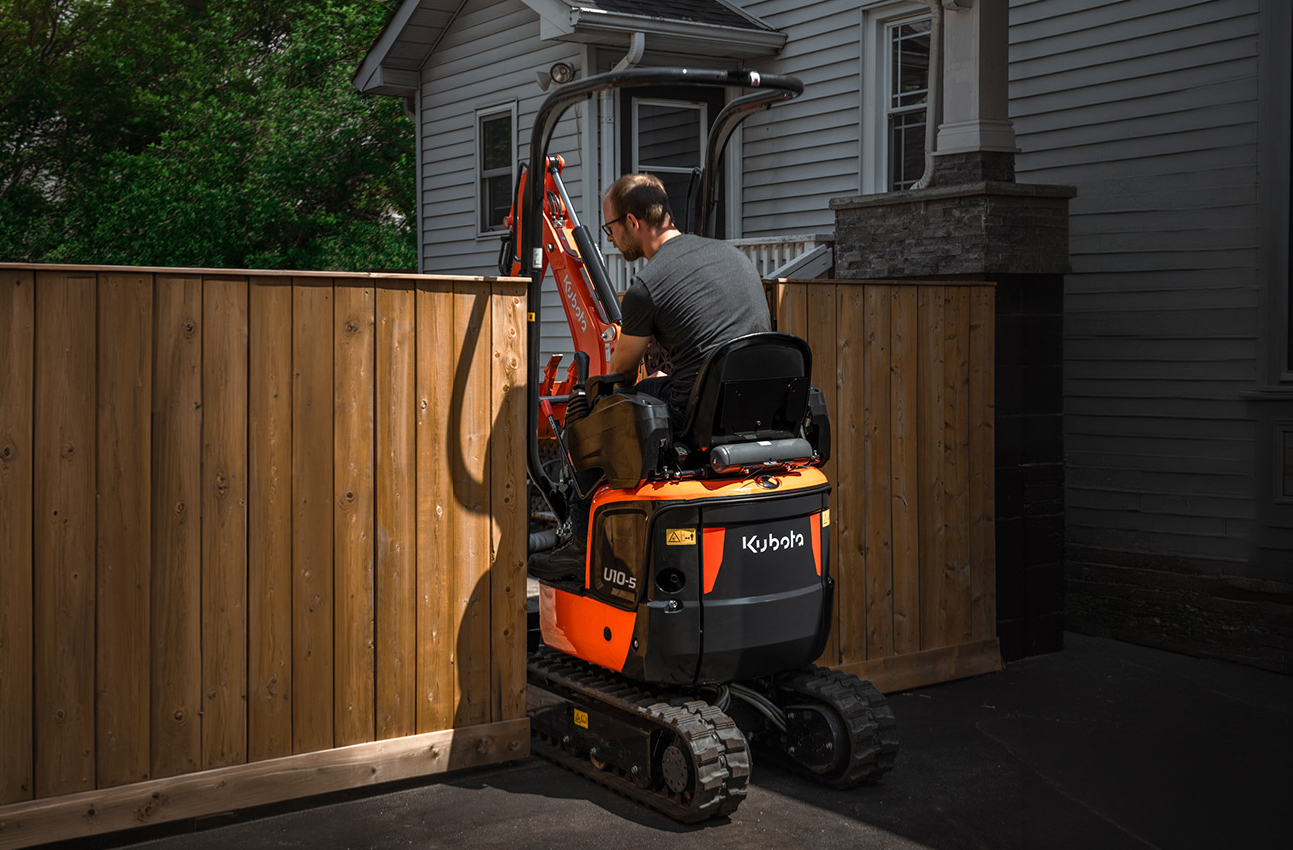
Most backyards are reached through a side gate, and many side gates are narrow. Measure the gate and the path past the AC unit, and bring the numbers to the rental counter.
Wait for the ground to dry
Wet clay and machines do not mix. Machines rut soaked ground, and the ruts bake hard into new low spots. PDQ's posted rental policies say that on rain days when you cannot use the equipment, PDQ must be notified the morning of that day so it can decide whether a credit can be extended. The signed rental contract is what governs, and for anything else, read the rental policies and ask.
Or hire it out
If the job involves the foundation, a slope, a property line or a lot of trench, a licensed contractor is usually the better call. That is a rental we do not get. Fine.
The Short Version
Test before you dig
A rain walk, a hose test and a perc hole find the real cause for the price of an afternoon.
Fix the free stuff first
Downspouts and sprinklers cause more soggy yards than bad soil does. Then wait for the next storm.
Clay is slow, not hopeless
Aeration, organic matter and less water help. Grading and drains handle what is left.
Some jobs need a pro
Foundations, slopes, retaining walls and anything near a property line go to an engineer or contractor.
Your Soggy Yard Checklist
- Where does each downspout actually put its water?
- Is the irrigation controller still on summer settings, and do any zones leak?
- During the hose test, does water move away from the house or toward it?
- How fast did the perc hole drain compared to a spot that drains well?
- Is there a patio, wall or planter sitting across the natural flow?
- Is any water coming from a slope, or from next door?
- Did I call 811 at least two working days before digging?
Straight Answers
Why does my yard flood every time it rains?
Usually a mix of slow-draining clay soil, compacted ground, flat or back-sloped grading, and downspouts or sprinklers putting extra water in the same low spot. A rain walk and a hose test will show which ones apply to your yard.
How do I test my yard drainage myself?
Dig a hole about 12 inches deep, fill it with water and let it drain, then refill it and measure how far the level drops in an hour. As a rough rule, under half an inch per hour is slow and an inch or more is fine. Call 811 at least two working days before digging.
How long should water stand in a yard after rain?
Puddles that are gone within a day are normal on clay. Water that stays more than a couple of days points to a drainage problem and can breed mosquitoes, which your county vector control district can help with.
Does clay soil cause yard drainage problems?
Yes. Expansive clay, common in parts of LA, Riverside and San Diego counties, takes water in slowly and swells when wet, so rain sits on top. Aeration and organic matter help, and grading or drains handle the rest.
Do I need a French drain to fix a soggy yard?
Often not. Extending downspouts, fixing irrigation and filling low spots solve many soggy yards. A French drain makes sense when the cheap fixes are done, the soil still holds water, and there is a legal place to send it.
Who do I call about yard drainage problems?
A licensed landscape or grading contractor for most yard drainage work. A civil engineer for slopes, retaining walls or water against the foundation. Your city or county for permits and questions about where water may be sent.
Fine, Here's the Sales Part
We just spent a couple thousand words telling you to grab a garden hose instead of renting from us. Honest or bad at marketing. Possibly both.
When the hose test is done and you know the job, tell us what you found, how wide your gate is and how much dirt is moving. We will tell you what to rent, what to skip, and when the honest answer is a contractor instead of a machine.
Seventy-some years of renting equipment, and the most useful drainage tool we know of is still a phone video taken during the rain.